Tianqiong Sensor IOT Technology Co., Ltd
Sales Manager:Ms. Emily Wang
Cel,Whatsapp,Wechat:+86 15898932201
Email:info@fengtutec.com
Add:No. 155 Optoelectronic Industry Accelerator, Gaoxin District, Weifang, Shandong, China


Sales Manager:Ms. Emily Wang
Cel,Whatsapp,Wechat:+86 15898932201
Email:info@fengtutec.com
Add:No. 155 Optoelectronic Industry Accelerator, Gaoxin District, Weifang, Shandong, China
time:2026-05-12 11:16:40 source:Weather Station viewed:4 time
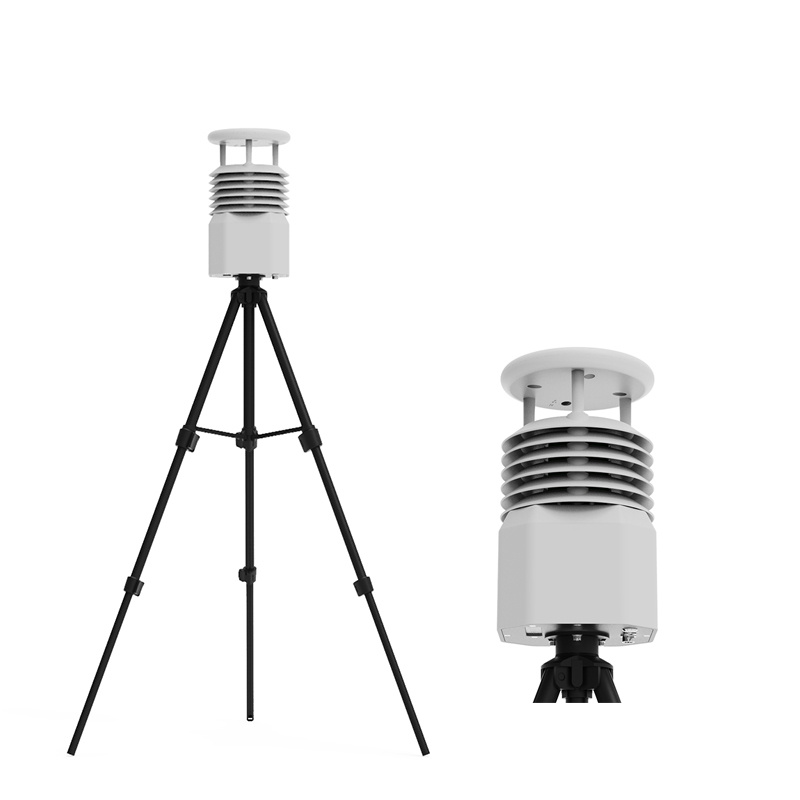
Portable Weather Station is a high-precision automatic observation device integrating wind speed, wind direction, temperature, humidity, and air pressure monitoring. It uses ultrasonic technology to measure wind speed and direction, eliminating the need for mechanical rotating parts. It supports rapid deployment without debugging and is suitable for various fields such as meteorology, agriculture, environmental protection, and marine science.
Portable Weather Station is a highly integrated, low-power, and quickly installable high-precision automatic meteorological observation device, mainly used for real-time monitoring of five core meteorological elements: wind speed, wind direction, air temperature, air humidity, and atmospheric pressure. The device consists of five parts: meteorological sensors, a data logger, a solar power system, a pole support, and a cloud platform. The entire unit is factory-installed and requires no debugging; it is ready to operate immediately after installation. It supports wired, Bluetooth, and GPRS transmission methods and is widely used in meteorology, agriculture, forestry, environmental protection, marine science, airports, ports, scientific research, and educational institutions.
In its core measurement principle, Portable Weather Station uses ultrasonic technology to measure wind speed and direction, eliminating the need for mechanical wind cups and wind vanes found in traditional weather stations. The device incorporates multiple ultrasonic transmitting and receiving probes. By emitting continuously variable frequency ultrasonic signals in different directions, it measures the time difference of sound wave propagation in the air. Compensation is then applied based on the effect of air temperature on sound speed to calculate wind speed and direction. The entire process involves no moving mechanical parts, fundamentally avoiding the long-term impact of mechanical wear, jamming, and environmental disturbances on measurement accuracy. The concealed ultrasonic probe design on the top cover effectively prevents rain and snow accumulation and physical obstruction of the measuring probe by natural wind, ensuring normal operation in all weather conditions, including heavy rain, snow, and frost.
Specifically, the ultrasonic anemometer has a range of 0 to 70 meters per second, a measurement accuracy of ±0.1 meters per second, and a resolution of 0.01 meters per second; the wind direction measurement range is 0 to 360 degrees, with an accuracy of ±1 degree and a resolution of 1 degree. Air temperature is measured using the diode junction voltage method, with a range of -40 to 85 degrees Celsius and an accuracy of ±0.3 degrees Celsius. Humidity is measured using a capacitive principle, with a range of 0 to 100% relative humidity and an accuracy of ±2% to ±3%. Atmospheric pressure is measured using a piezoresistive sensor, with a range of 300 to 1100 hPa and an accuracy of ±0.02 hPa.
From a product structure perspective, the sensor housing of Portable Weather Station is made of imported ASA or ABS material, effectively resisting salt spray and outdoor corrosive environments, achieving a protection level of IP65 or higher. The data logger connects to the sensor via a Modbus 485 interface, and a GPRS wireless transmission module is standard, with optional RJ45, 4G, Bluetooth, LoRa transparent transmission, and other communication methods. Power supply supports solar panels and lead-acid batteries, equipped with an MPPT automatic power point tracking charging controller, suitable for unattended scenarios without power grid coverage in the field. The data upload interval can be freely adjusted from 1 minute to 1000 minutes, and users can view data and historical curves in real time through PC software or a mobile APP. The cloud platform also supports SMS alerts, automatically sending reminder SMS messages to designated mobile phone numbers when a meteorological parameter exceeds a preset threshold.
In terms of application areas, Portable Weather Station can flexibly configure sensor combinations for specific scenarios. In agricultural production, the equipment is used to monitor farmland microclimates, guiding irrigation, fertilization, and pest and disease control; in environmental protection, it is used for regional atmospheric environmental monitoring and pollution source tracing; in transportation hubs such as airports and ports, it provides local wind field and temperature/pressure data for takeoff and landing safety and ship scheduling; in scientific research and school education, it provides a portable and lightweight field teaching tool. The portable Portable Weather Station weighs less than 5 kg, and a single person can complete on-site deployment within 2 minutes, making it particularly suitable for emergency meteorological observation and short-term mobile monitoring needs. Furthermore, the equipment can be expanded with optional sensors such as rainfall, light intensity, carbon dioxide concentration, and PM2.5, further enriching its application range and capabilities, playing an indispensable role in multiple fields such as meteorological forecasting, climate research, and agricultural production.
Real Time PCR is a high-precision instrument for real-time monitoring of the PCR amplification process, featuring an 8-well single-channel design. By combining PCR amplification and fluorescence detection technology, it enables rapid and accurate quantitative analysis of nucleic acid targets,...
Rat Bait Station utilizes the Internet of Things (IoT) and intelligent recognition technology to achieve 24/7 rodent activity data collection and remote control management....
Rainwater conditions refer to the real-time status and changing trends of hydrological elements such as precipitation, water level, and flow. They are the core basis for water resource management and disaster prevention and mitigation. Precipitation replenishes surface and groundwater sources in the...
In the fields of meteorological monitoring and hydrology, the piezoelectric rain gauge and the Radar Precipitation Sensor Rain Gauge Distrometer are commonly used rainfall monitoring devices. Today, the author will compare the differences between the two.The piezoelectric rain gauge works by u...



 Skype
Skype
 whatsapp
 mail
mail