Tianqiong Sensor IOT Technology Co., Ltd
Sales Manager:Ms. Emily Wang
Cel,Whatsapp,Wechat:+86 15898932201
Email:info@fengtutec.com
Add:No. 155 Optoelectronic Industry Accelerator, Gaoxin District, Weifang, Shandong, China


Sales Manager:Ms. Emily Wang
Cel,Whatsapp,Wechat:+86 15898932201
Email:info@fengtutec.com
Add:No. 155 Optoelectronic Industry Accelerator, Gaoxin District, Weifang, Shandong, China
time:2026-05-09 10:52:44 source:Weather Station viewed:7 time
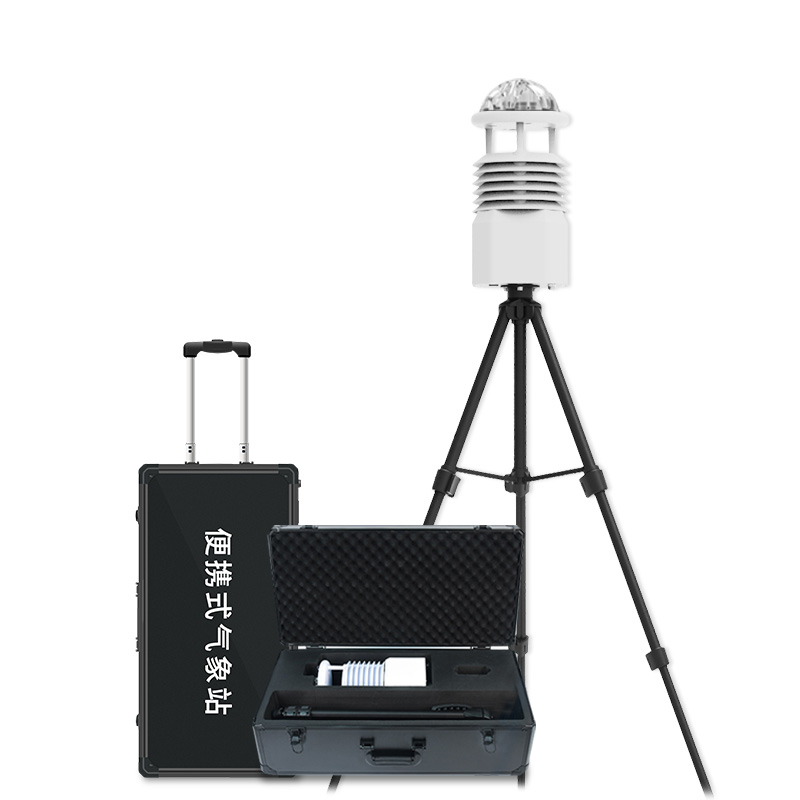
The Wireless Weather Station integrates six sensors: wind speed, wind direction, temperature, humidity, air pressure, and optical rainfall. Its concealed ultrasonic probe avoids interference from rain and snow accumulation and wind obstruction. It measures wind speed and direction by emitting continuous frequency ultrasonic signals to measure relative phase. Standard configuration includes GPRS, Bluetooth, and 485 to USB transmission options. Accessories include an aluminum alloy telescopic stand and a shock-absorbing protective trolley case for easy portability and field deployment.
The Wireless Weather Station is a ground-based automatic observation device that simultaneously monitors six basic meteorological elements: wind speed, wind direction, temperature, humidity, air pressure, and optical rainfall. The device features a concealed ultrasonic probe design, with the probe embedded in the top of the device. The flat top surface effectively avoids interference from rain and snow accumulation and eliminates the impact of wind obstruction on measurement accuracy. The wind speed and direction measurement principle involves emitting continuously variable frequency ultrasonic signals and detecting wind speed and direction by measuring the relative phase. This eliminates the need for mechanical rotating parts, avoids wear issues, and significantly extends the maintenance-free period. The wind speed measurement range covers 0 to 70 meters per second, and the wind direction measurement accuracy reaches ±3 degrees. Temperature, humidity, air pressure, and rainfall sensors are highly integrated with the wind speed and direction sensors, forming a six-element integrated structure. The entire unit is compact and easy to install.
Wireless Weather Station comes standard with three transmission methods: GPRS, Bluetooth, and 485 to USB, allowing users to flexibly choose according to on-site communication conditions. GPRS wireless transmission is suitable for field environments without fixed networks, Bluetooth connectivity allows on-site personnel to directly read real-time data using mobile phones or tablets, and 485 to USB wired transmission is suitable for research institutions and meteorological stations to connect to local data acquisition systems. The data upload interval is adjustable, with a minimum interval of 1 minute, meeting the needs of refined monitoring. The solar power supply system uses MPPT automatic power point tracking technology, ensuring normal operation of the equipment even under continuous cloudy and rainy conditions. The aluminum alloy bracket features a telescopic design, allowing for adjustable pole height and facilitating rapid installation in various terrain conditions. The entire unit is housed in a shock-absorbing and protective carrying case. The sensors are integrated into a single structure, eliminating the need for on-site assembly; simply open the case to begin operation, making it suitable for mobile meteorological monitoring and emergency observation tasks.
In terms of applications, Wireless Weather Station is widely deployed in meteorological observation stations, agricultural greenhouses, ski resorts, water conservancy projects, and transportation hubs. Meteorological departments use this type of equipment to build high-density observation networks, eliminating blind spots in severe weather monitoring. Regional meteorological stations in water conservancy projects can collect key parameters such as rainfall and wind speed in real time, providing decision-making support for reservoir construction and flood season scheduling. Industrial parks and airports/ports utilize six-element meteorological stations to achieve localized meteorological environment monitoring; combined with a cloud platform, remote data viewing and over-limit alarms are possible. The equipment boasts low power consumption, requires no daily maintenance, and can operate continuously unattended around the clock.
This detector can complete the processes of pine wilt nematode isolation, DNA extraction, and quantitative PCR detection. It features a built-in automated detection program, eliminating the need for complex parameter settings and allowing for one-button operation. This four-...
In the field of meteorological monitoring, refined monitoring has become a trend. As an important part of refined monitoring, micro-meteorological monitoring is dedicated to obtaining more accurate and detailed meteorological information. It focuses on the changes of meteorological elements within a...
Transgene detection is a food testing device based on real-time quantitative fluorescence PCR technology, capable of performing qualitative detection of animal-derived ingredients such as pork, beef, mutton, chicken, and duck. By extracting DNA from meat samples and subjecting it to amplificat...
Soil moisture monitoring is a crucial link in modern agricultural water-saving and drought resistance. By scientifically measuring and analyzing soil moisture conditions, it provides accurate data support for irrigation decisions and drought resistance scheduling, which is of great significance for...


 Skype
Skype
 whatsapp
 mail
mail