Tianqiong Sensor IOT Technology Co., Ltd
Sales Manager:Ms. Emily Wang
Cel,Whatsapp,Wechat:+86 15898932201
Email:info@fengtutec.com
Add:No. 155 Optoelectronic Industry Accelerator, Gaoxin District, Weifang, Shandong, China


Sales Manager:Ms. Emily Wang
Cel,Whatsapp,Wechat:+86 15898932201
Email:info@fengtutec.com
Add:No. 155 Optoelectronic Industry Accelerator, Gaoxin District, Weifang, Shandong, China
time:2026-03-19 11:19:19 source:Weather Station viewed:204 time
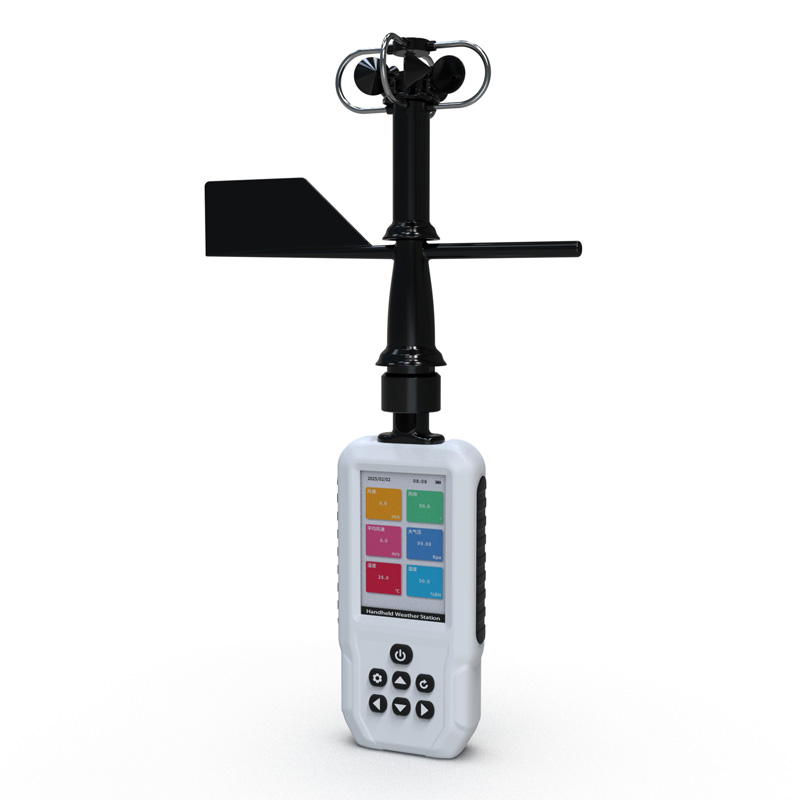
High-Precision Handheld 9-Parameter Weather Station integrates measurement functions for wind speed, wind direction, temperature, humidity, atmospheric pressure, altitude, heat index, and wet-bulb temperature. With a wind speed accuracy of ±0.3 m/s, a temperature accuracy of ±0.2°C, and a humidity accuracy of ±2%, it is ideally suited for rapid observation requirements in laboratories, scientific research environments, and industrial field sites.
High-Precision Handheld 9-Parameter Weather Station is a portable, multi-parameter meteorological measurement device designed specifically to meet the demands for rapid on-site observation in laboratory, research, and industrial settings. This device integrates nine distinct measurement functions—including wind speed, wind direction, average wind speed, temperature, humidity, atmospheric pressure, altitude, heat index, and wet-bulb temperature—into a single handheld terminal. It can complete measurements for all parameters and display the results within a matter of seconds, providing immediate meteorological data support for fields such as disaster prevention and mitigation, agricultural production, urban planning, and scientific research.
Regarding wind speed and direction measurements, the device employs either ultrasonic or mechanical sensor technologies. The wind speed measurement range spans 0 to 60 meters per second, with an accuracy of ±0.3 m/s and a resolution of 0.01 m/s. The wind direction measurement range covers 0 to 360 degrees, with an accuracy of ±3 degrees and a resolution of 0.1 degrees. Additionally, the device features an average wind speed calculation function to satisfy the diverse wind parameter measurement requirements of various application scenarios.
The temperature and humidity sensors utilize high-precision digital chips. The temperature measurement range extends from -40°C to 125°C, with an accuracy of ±0.2°C and a resolution of 0.1°C. The humidity measurement range covers 0% to 100% Relative Humidity (RH), with an accuracy of ±2% RH and a resolution of 0.1% RH. Atmospheric pressure is measured using a piezoresistive sensor, offering a measurement range of 30 to 110 kPa, an accuracy of ±0.1 kPa, and a resolution of 0.01 kPa. Based on the atmospheric pressure data, the device can calculate altitude, covering a range of 0 to 9,165 meters with an accuracy of ±1 meter.
The heat index and wet-bulb temperature are critical indicators for assessing environmental heat stress. The device automatically calculates the heat index based on the ambient temperature and humidity, providing a measurement range of -40 to 140 with an accuracy of ±0.2. The wet-bulb temperature is calculated based on temperature and humidity data, eliminating the need for additional wet-bulb gauze or manual water replenishment.
The device features low overall power consumption and is powered by a rechargeable lithium battery, offering a continuous operating time of over 8 hours. The display screen provides real-time readouts of all measured parameters; the user interface is intuitive, and the device supports data storage and export functions. Optional RS485 or Bluetooth communication interfaces are available, facilitating easy connectivity with mobile apps or PC software for in-depth data analysis.
In practical applications, this handheld weather station can be utilized in agriculture to conduct microclimate surveys in fields and assess crop growth environments. In the industrial sector, it serves to monitor workshop conditions, ensuring that production environments meet specific process requirements. Researchers conducting fieldwork can rapidly acquire meteorological data from multiple locations to support comparative climate studies. Furthermore, emergency management personnel can monitor real-time temperature, humidity, and wind conditions at disaster sites, providing critical data to inform rescue and response decisions.
Faced with numerous types of anemometers on the market, how can one select a product that meets their own needs? First, let's understand the common types of anemometers.Mechanical AnemometerAmong mechanical anemometers, the cup anemometer is relatively common. It relies on the rotation of cups u...
The Atmospheric Visibility Sensor is a device that accurately acquires atmospheric visibility data.The working principle of the Atmospheric Visibility Sensor is based on the theory of light scattering. The instrument is equipped with a light source of a specific wavelength, mostly an infrared LED li...
Within the meteorological observation system, meteorological stations encompass various types such as National Climate Observatories, National Reference Climate Stations, National Basic Meteorological Stations, National Meteorological Observation Stations, and Regional Automatic Meteorological Stati...
Handheld Anemometer is a portable meteorological observation instrument that integrates the measurement of wind speed, wind direction, and average wind speed into a single unit. It features a wind speed measurement range of 0–60 m/s with an accuracy of ±0.3 m/s, and a wind direction range of...


 Skype
Skype
 whatsapp
 mail
mail