Tianqiong Sensor IOT Technology Co., Ltd
Sales Manager:Ms. Emily Wang
Cel,Whatsapp,Wechat:+86 15898932201
Email:info@fengtutec.com
Add:No. 155 Optoelectronic Industry Accelerator, Gaoxin District, Weifang, Shandong, China


Sales Manager:Ms. Emily Wang
Cel,Whatsapp,Wechat:+86 15898932201
Email:info@fengtutec.com
Add:No. 155 Optoelectronic Industry Accelerator, Gaoxin District, Weifang, Shandong, China
time:2025-07-18 08:56:48 source:Weather Station viewed:654 time
Faced with numerous types of anemometers on the market, how can one select a product that meets their own needs? First, let's understand the common types of anemometers.
Mechanical Anemometer
Among mechanical anemometers, the cup anemometer is relatively common. It relies on the rotation of cups under the action of wind, which drives the sensor to output pulse signals. Wind speed is proportional to the rotation speed, and wind speed is calculated based on this relationship. It has a simple structure, low cost, and is easy to operate, making it suitable for scenarios with low precision requirements and relatively mild environments, such as agricultural weather stations and small ventilation systems. However, its mechanical components are susceptible to erosion by dust and rain. After long-term use, the frictional resistance increases, which will lead to measurement deviations. In environments with strong winds or large temperature changes, its stability is poor.
Ultrasonic Anemometer
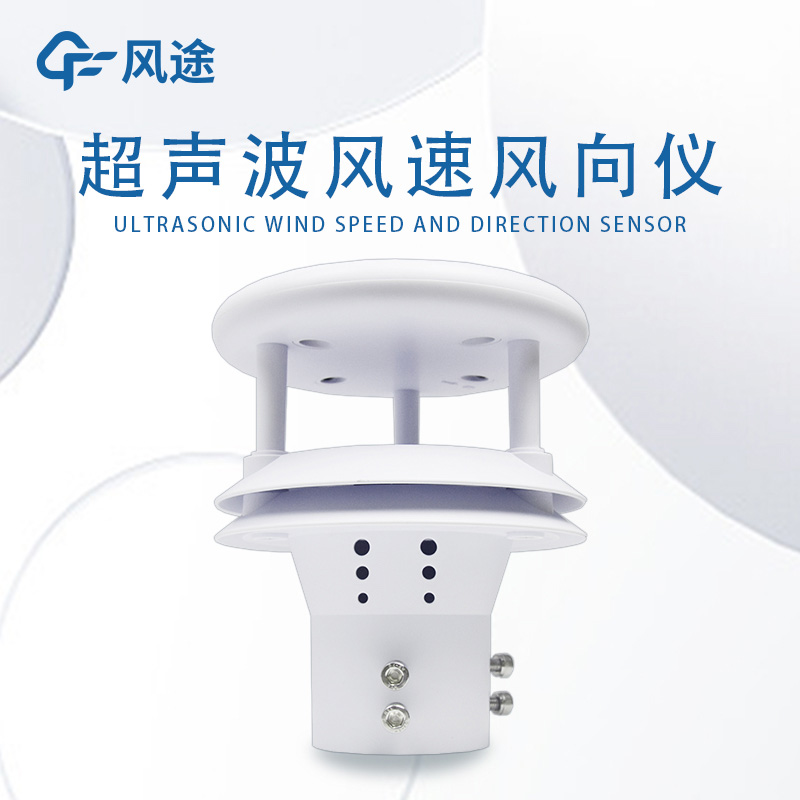
Ultrasonic anemometers calculate wind speed and direction using the time difference of sound wave propagation in the air flow. This type of anemometer has no mechanical moving parts, avoiding wear issues, and features high reliability and long service life. It is suitable for scenarios requiring continuous operation, such as urban environmental monitoring and industrial ventilation ducts. It is highly sensitive to air flow direction and can accurately detect instantaneous changes. However, in rainy or snowy weather or when there are many particles in the air, the propagation of sound waves will be disturbed. It is necessary to ensure data accuracy through algorithm compensation or adding self-cleaning functions.
Laser Doppler Anemometer
Laser Doppler anemometers are based on the laser Doppler effect, calculating wind speed by measuring the frequency change of laser scattered by tiny particles in the air flow. It does not need direct contact with the air flow, enabling non-intrusive measurement, and can accurately detect instantaneous changes in high-speed air flow. It is suitable for high-precision scenarios such as aerospace wind tunnel experiments and gas turbine flow field analysis. It has high spatial resolution and can obtain the three-dimensional velocity distribution of the air flow. However, the equipment cost is high, and it has strict requirements on the operating environment, needing to avoid strong electromagnetic interference and vibration. Moreover, the measurement results are easily affected by the concentration of particles in the air flow, and additional tracer particles need to be introduced in clean air flow environments.
In summary, choosing a suitable anemometer requires comprehensively considering the characteristics of each type and actual needs. Mechanical anemometers, with simple structures and low costs, are suitable for scenarios with low precision requirements and mild environments, such as agricultural weather stations, but their mechanical components are prone to wear and have poor stability in strong winds or large temperature differences. Ultrasonic anemometers, without mechanical components and with long service lives, are suitable for continuous operation scenarios such as urban environmental monitoring, and are sensitive to wind direction. However, they are easily disturbed in rainy, snowy, or particle-rich environments, requiring algorithm compensation or self-cleaning functions. Laser Doppler anemometers, with non-intrusive measurement and high precision, are suitable for high-precision scenarios such as aerospace wind tunnel experiments and have high spatial resolution, but they are costly, have strict environmental requirements, and are greatly affected by particle concentration.
Under harsh low - temperature and freezing conditions, anemometers and wind vanes are highly prone to malfunction. As a result, the errors in the collected data increase significantly. Although these devices are equipped with heating units, the units only function on the rotating parts. Once severel...
The crop growth condition is an important term in the agricultural field, referring to the growth and development status of crops at various stages from sowing to maturity. It includes comprehensive information such as plant morphology, population structure, and physiological indicators, and is cruc...
In the field of geological hazard monitoring and early warning (such as landslides, collapses, ground subsidence, debris flows, etc.), GNSS monitoring stations are a core technical means used for accurately measuring surface displacement and deformation.GNSS equipment precisely determines its absolu...
The Portable el detector is an important device used to detect various defects in photovoltaic (PV) cell modules. It can accurately detect defects such as hidden cracks, fragments, and poor soldering in PV cell modules. These internal defects can seriously affect the service life and long-term power...


 Skype
Skype
 whatsapp
 mail
mail