Tianqiong Sensor IOT Technology Co., Ltd
Sales Manager:Ms. Emily Wang
Cel,Whatsapp,Wechat:+86 15898932201
Email:info@fengtutec.com
Add:No. 155 Optoelectronic Industry Accelerator, Gaoxin District, Weifang, Shandong, China


Sales Manager:Ms. Emily Wang
Cel,Whatsapp,Wechat:+86 15898932201
Email:info@fengtutec.com
Add:No. 155 Optoelectronic Industry Accelerator, Gaoxin District, Weifang, Shandong, China
time:2025-07-10 08:54:53 source:Weather Station viewed:455 time
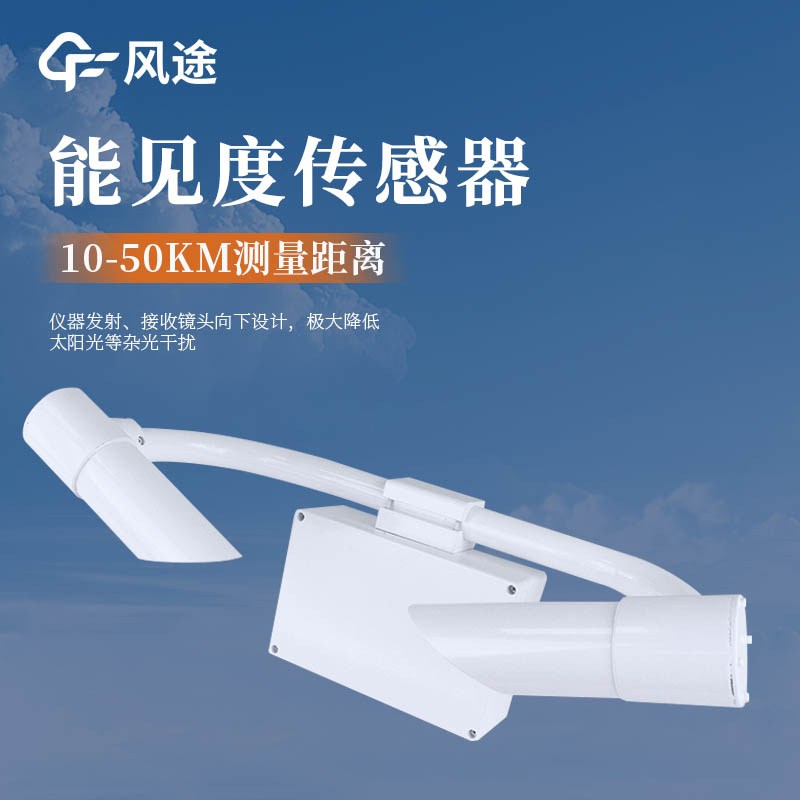
The Atmospheric Visibility Sensor is a device that accurately acquires atmospheric visibility data.
The working principle of the Atmospheric Visibility Sensor is based on the theory of light scattering. The instrument is equipped with a light source of a specific wavelength, mostly an infrared LED light source. When the light emitted by the light source propagates in the atmosphere, it interacts with particles in the air such as fog droplets, dust, and smoke, resulting in a scattering phenomenon. The detector specifically detects the intensity of scattered light at a specific forward angle, converts the scattered light intensity data into an atmospheric extinction coefficient through a precise algorithm combined with known optical parameters, and then derives the visibility value. In the detector based on the 35° forward scattering principle, the focus is mainly on analyzing and processing the scattered light signal at this angle.
In terms of device structure, the Atmospheric Visibility Sensor is mainly composed of a transmitting unit, a receiving unit, and a signal processing unit. The transmitting unit is responsible for stably emitting light of a specific wavelength; the receiving unit is used to capture the scattered light signal at a specific forward angle, and its sensitivity and accuracy directly affect the quality of data collection; the signal processing unit performs complex calculations and processing on the signals from the receiving unit, and finally outputs the visibility data. Different models of detectors vary in structural details. For example, some are specially designed for air meteorological data monitoring of unmanned aircraft or small unmanned inspection vehicles. They have a compact and flat shape, are hoisted on the belly of the aircraft, and have low wind resistance. Users can choose ABS and aluminum alloy shell materials, as well as configurations such as temperature, humidity, and air pressure sensors according to their needs.
It is a key device for obtaining visibility data. Installed on meteorological monitoring stations, it can provide basic data for weather forecasting and help meteorological departments issue early warnings for low-visibility weather such as heavy fog and sandstorms in a timely manner. Airports use it to ensure the safety of aircraft takeoffs and landings, ports use it for ship navigation, and highways rely on it to prevent traffic accidents in severe weather such as sudden fog. Portable visibility detectors can be quickly deployed on mobile monitoring vehicles, forming a complementary network with fixed visibility stations, and real-time data is transmitted back to the tower command system to provide a basis for controllers to make takeoff and landing decisions; at tunnel entrances, mountain bends and other road sections where sudden fog frequently occurs on highways, the detectors can quickly form a network for monitoring. When a sudden drop in visibility is detected, they can directly trigger linked measures such as enhanced tunnel lighting and changes in speed limit signs.
As night fell, I was flying through the darkness as usual. Suddenly, I spotted a beam of light that lured insects ahead. Driven by instinct, my companions and I flew towards the light source without hesitation. Later I came to know that it was actually a nightmare from which there was no escape. Tha...
In the fields of solar energy resource assessment and meteorological monitoring, the Fully Automatic Solar Spectrometer is revolutionizing traditional measurement methods. This instrument combines multi - spectral filters with thermopiles to capture radiant energy within the spectral range of 280 to...
The Water Quality Monitoring Buoy is an unattended field device that integrates multiple water quality monitoring sensors onto a buoy, which is deployed in water bodies requiring monitoring. It enables real-time online water quality monitoring. By leveraging technologies such as on-site sensor monit...
Agricultural Weather Stations,Customizable Parameters and Intelligent Monitoring as Key Tools for Scientific Decision-making in AgricultureAgricultural Weather Stations enable free customization of parameters and intelligent monitoring, serving as vital tools for scientific decision-making in agricu...


 Skype
Skype
 whatsapp
 mail
mail