Tianqiong Sensor IOT Technology Co., Ltd
Sales Manager:Ms. Emily Wang
Cel,Whatsapp,Wechat:+86 15898932201
Email:info@fengtutec.com
Add:No. 155 Optoelectronic Industry Accelerator, Gaoxin District, Weifang, Shandong, China


Sales Manager:Ms. Emily Wang
Cel,Whatsapp,Wechat:+86 15898932201
Email:info@fengtutec.com
Add:No. 155 Optoelectronic Industry Accelerator, Gaoxin District, Weifang, Shandong, China
time:2025-09-10 09:07:26 source:Weather Station viewed:403 time
Within the meteorological observation system, meteorological stations encompass various types such as National Climate Observatories, National Reference Climate Stations, National Basic Meteorological Stations, National Meteorological Observation Stations, and Regional Automatic Meteorological Stations. The Ultrasonic Weather Station falls under the category of automatic meteorological stations and serves as a crucial component of the meteorological observation network.
As an automatic meteorological station, the Ultrasonic Weather Station relies on advanced telemetry technology. It enables automatic collection, storage, and transmission of meteorological parameter data in specific areas without the need for on-site personnel supervision, making it a typical unattended meteorological station. This automated operation mode not only effectively reduces labor costs but also ensures the continuity and stability of meteorological data collection. It avoids human interference in the observation process, providing strong support for the accuracy of meteorological data.
Surface meteorological observation elements include numerous items such as air pressure, air temperature, air humidity, precipitation, wind direction, and wind speed. The Ultrasonic Weather Station mainly focuses on observing six key elements among them, specifically air temperature, air humidity, air pressure, precipitation, wind speed, and wind direction. These six elements are fundamental indicators reflecting the meteorological conditions of a region, and they can provide core data support for meteorological analysis, weather forecasting, and decision-making in related fields.
The data collection and update frequency of the Ultrasonic Weather Station is set in a scientific and efficient manner. It can collect one set of observation data per minute. For the convenience of data aggregation, analysis, and application, the Ultrasonic Weather Station updates the observation data once per hour. After integrating and processing the observation data within one hour, it transmits the data to relevant data platforms. This ensures that meteorological data can promptly and effectively serve various needs, and the station is widely used in fields such as meteorological monitoring, agricultural production, environmental protection, and transportation.
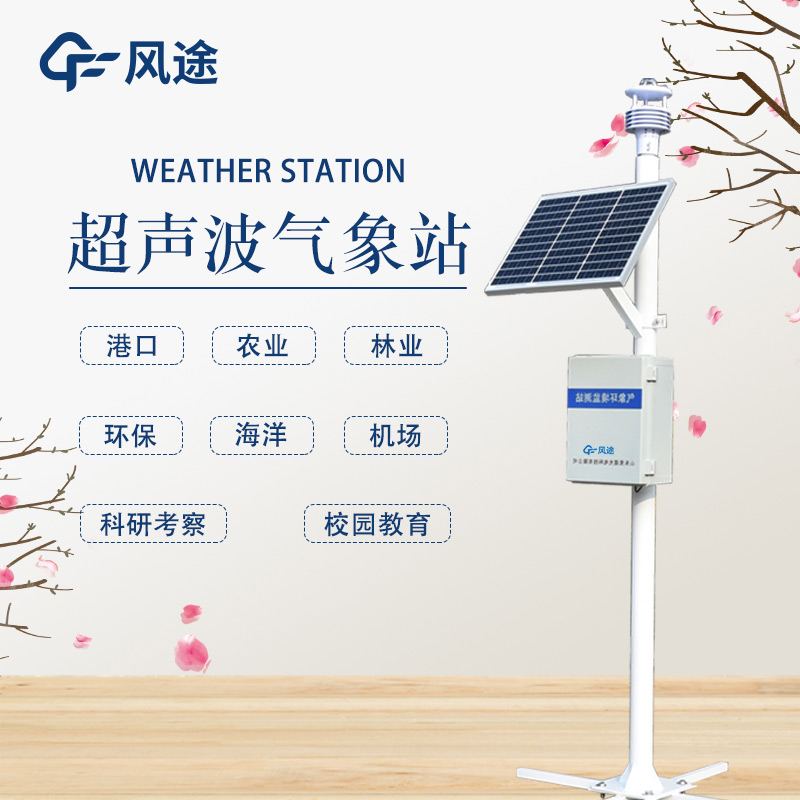
The FT-WQX6 micro weather sensor is a highly integrated device that combines multiple meteorological parameter measurement functions. Its key feature is the integration of six basic meteorological parameters—ambient temperature, relative humidity, wind speed, wind direction, atmospheric pressure, a...
This instrument integrates FDR (Frequency Domain Reflectometry) principle soil moisture measurement sensors and data acquisition technology. Through moisture and temperature sensors, it accurately measures soil volumetric water content (VWC) and temperature. Powered by solar energy, it is adap...
Instrument for measuring water flow velocity consists of a propeller-type flow velocity sensor, a flow velocity calculator, and a measuring rod. It features a velocity measurement range of 0.06 to 8.00 m/s and a measurement error margin of ≤1.5%. Once the signal cable is connected, the device...
In the photovoltaic field, "black heart" is a serious quality issue, manifested as the luminous intensity of some areas inside the photovoltaic module being significantly lower than the normal level, presenting black or dark areas. This indicates that the performance of the battery cells i...


 Skype
Skype
 whatsapp
 mail
mail