Tianqiong Sensor IOT Technology Co., Ltd
Sales Manager:Ms. Emily Wang
Cel,Whatsapp,Wechat:+86 15898932201
Email:info@fengtutec.com
Add:No. 155 Optoelectronic Industry Accelerator, Gaoxin District, Weifang, Shandong, China


Sales Manager:Ms. Emily Wang
Cel,Whatsapp,Wechat:+86 15898932201
Email:info@fengtutec.com
Add:No. 155 Optoelectronic Industry Accelerator, Gaoxin District, Weifang, Shandong, China
time:2025-09-03 09:01:49 source:Weather Station viewed:478 time
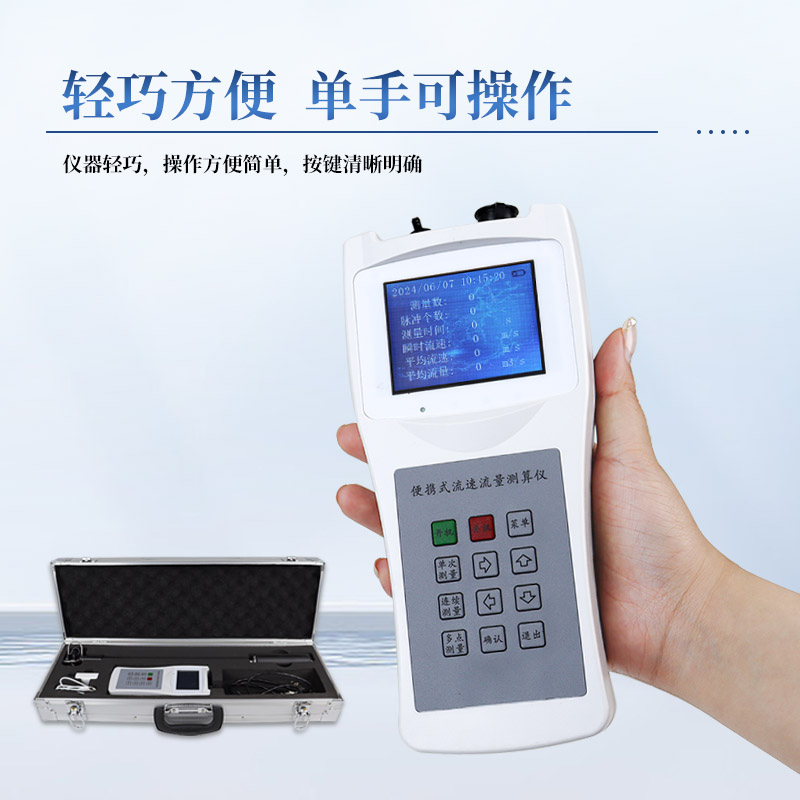
As a device widely used in fields such as water conservancy monitoring, environmental governance, and engineering construction, a flow meter can monitor water flow velocity data in real time with high accuracy, providing a scientific basis for decision-making. Currently, mainstream flow meters on the market mainly adopt two core measurement technologies: radar and ultrasonic. Each of these two technologies has its own advantages and can meet the velocity measurement needs in different scenarios.
Radar-based flow meters achieve measurement based on the Doppler effect. The device emits radar waves of a specific frequency; when these waves hit the water surface, they are reflected. Due to the movement of the water flow, the frequency of the reflected waves shifts. By calculating the frequency shift and combining it with a preset algorithm, the device directly obtains the water flow velocity. This type of flow meter does not require direct contact with the water flow. During installation, it only needs to be fixed on structures such as bridges or shore brackets to realize non-contact measurement. Its advantages include strong anti-interference ability, as it is not affected by impurities in the water such as sediment and floating objects, and a wide application range. It can work stably in both natural water bodies like rivers and lakes, and artificial water bodies such as channels and reservoirs. It is particularly suitable for complex water flow environments with high flow velocity and high turbidity. In river flood prevention monitoring, it can quickly detect changes in flow velocity and issue early warnings for flood peaks; in urban waterlogging prevention and control, it can real-time measure the velocity of accumulated water on streets and link with traffic signals to ensure safety.
Ultrasonic-based flow meters, on the other hand, operate by utilizing the propagation characteristics of ultrasonic waves in water. Such devices are usually equipped with two ultrasonic transducers: one for transmission and one for reception. The transmitting transducer emits ultrasonic signals into the water flow; during propagation, these signals generate a time difference due to the movement of the water. After the receiving transducer captures the signals, the device calculates the water flow velocity based on the correlation formula between the time difference and water flow velocity. This type of flow meter features high measurement accuracy, enabling precise monitoring of changes in low-velocity water flow. It is suitable for scenarios with high requirements for velocity measurement accuracy, such as laboratory water flow research and small-scale channel flow monitoring. It has a relatively compact structure and flexible installation methods, which can be fixed underwater or installed in a floating manner to meet the needs of different monitoring points. In irrigation area flow metering, it can accurately calculate flow to improve water resource utilization efficiency; in hydropower station operation optimization, it can real-time monitor outflow distribution to enhance the power generation efficiency of water turbines.
Whether it is the convenience and anti-interference capability of radar-based flow meters or the high accuracy and sensitivity of ultrasonic-based ones, both types of flow meters share common advantages such as real-time data transmission, strong battery life, and simple operation. They can be adapted to multiple terminals such as computers and mobile phones for data viewing, providing users with efficient and reliable water flow monitoring solutions and helping various industries achieve refined water flow management.
To measure water levels, a Radar Water Level Sensor is required, such as the YW-76 introduced today. Let's take an in-depth look at its advantages and working principle.1. High-frequency Technology Ensures Measurement AccuracyThe YW-76 horn-type Radar Water Level Sensor adopts Frequency Modulate...
Negative oxygen ions exert a significant impact on the physiological activities of the human body, and their effects are mainly realized through the nervous system and blood circulation process. For this reason, the concentration of negative oxygen ions in the air has become one of the key indicator...
This instrument integrates FDR (Frequency Domain Reflectometry) principle soil moisture measurement sensors and data acquisition technology. Through moisture and temperature sensors, it accurately measures soil volumetric water content (VWC) and temperature. Powered by solar energy, it is adap...
Five Elements Micrometeorological Instrument, model FT-WQX5S, features an exterior made of stainless steel. This material not only boasts high strength, capable of withstanding a certain degree of external impact, but also exhibits excellent anti-oxidation and anti-corrosion properties. This makes i...


 Skype
Skype
 whatsapp
 mail
mail