Tianqiong Sensor IOT Technology Co., Ltd
Sales Manager:Ms. Emily Wang
Cel,Whatsapp,Wechat:+86 15898932201
Email:info@fengtutec.com
Add:No. 155 Optoelectronic Industry Accelerator, Gaoxin District, Weifang, Shandong, China


Sales Manager:Ms. Emily Wang
Cel,Whatsapp,Wechat:+86 15898932201
Email:info@fengtutec.com
Add:No. 155 Optoelectronic Industry Accelerator, Gaoxin District, Weifang, Shandong, China
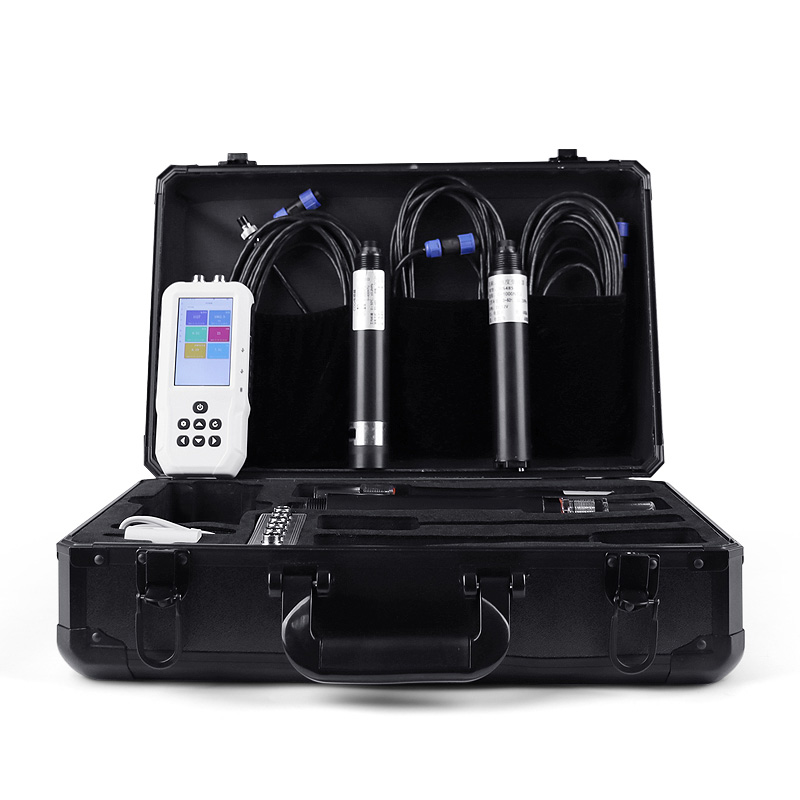
Model:FT-SS16S
Brand:tianqiong
1.Introduction to Blue-Green Algae Sensor Products
Blue-Green Algae Sensor measures blue-green algae in real time via fluorometry and is ideal for monitoring water stations, surface water, and other applications.Blue-Green Algae Sensor is an electrode-based water quality analysis instrument that uses all-digital electrode detection to detect the blue-green algae parameters of water quality.The instrument is equipped with a self-developed FTIOT operating system, which has simple operation, stable performance, accurate measurement, wide detection range, and has a built-in high-capacity rechargeable lithium battery, which is convenient for users to conduct water quality inspection at any time in the field and in the laboratory.
2.Blue-Green Algae Sensor host parameters
| Charging input voltage | 4.5V-5.5V |
| Charging current | <2A |
| Screen size | 3.5 inches |
| Screen resolution | 480*800☆ |
| Screen interface | MIPI DSI☆ |
| USB port | 2 (Support external expansion of mouse, keyboard, 4G, etc.)☆ |
| Type-C | 1 (Support external expansion of mouse, keyboard, 4G, etc.)☆ |
| RS485 | 2 (Support Modbus, json, asc input, etc.) |
| External sensor power supply voltage | 12V |
| External sensor power supply current | 1A |
| operating system | ftiot (based on Linux-5.4)☆ |
| CPU | 2*Cotex-A7, 650Mhz☆ |
| RAM | 512M DDR3☆ |
| Flash | 8G-64G |
| OpenGL | ES 2.0☆ |
| Wifi | support |
| 4G | Selection |
| button | support |
| Capacitive touch screen | support |
| Software Architecture | B/S☆ |
| Web access | Support ☆ |
| MTP mode | Support ☆ |
| Multi-terminal login | Support ☆ |
| IPV6 | Support ☆ |
| Sensor communication method | RS485, TCP, UDP, Http☆ |
| Data forwarding method | RS485, TCP, UDP, Http☆ |
| Remote SSH | Support ☆ |
| Remote debugging | Support ☆ |
3.Blue-Green Algae Sensor parameters and configuration
| Serial number | name | Measurement range | principle | Measurement accuracy | Resolution | Configuration | Remark |
| 1 | temperature | 0~50℃ | High-precision digital sensor | ±0.3℃ | 0.01℃ | ||
| 2 | pH | 0~14 (ph) | Electrochemistry (salt bridge) | ±0.1PH | 0.01 | ||
| 3 | ORP | -1500mv~1500mv | Electrochemistry (salt bridge) | ±6mv | 1mV | ||
| 4 | Conductivity | 0~5000uS/cm, 0~10000uS/cm | Contact electrode method | ±1.5% | 1uS/cm | ||
| 5 | TDS | 0-10000ppm 0-200ppt | Contact electrode method | ±1.5%; ±0.1°C | 1ppm 0.01ppt | ||
| 6 | salinity | 0-10000ppm 0-200ppt | Contact electrode method | ±1.5%; ±0.1°C | 1ppm 0.01ppt | ||
| 7 | Sludge concentration | 0~20.000g/L | Scattering light method | ±5% (depending on sludge homogeneity) | 0.001g/L | ||
| 8 | Turbidity | 0~40NTU (low turbidity) | Scattering light method | ±1% | 0.1NTU | Optional | |
| 0~1000NTU (medium turbidity) | Scattering light method | ±1% | |||||
| 0~3000NTU (high turbidity) | Scattering light method | ±1% | |||||
| 9 | Dissolved oxygen | 0~20mg/L | Fluorescence life method | ±2% | 0.01mg/L | ||
| 10 | Ammonia nitrogen | 0-1000.00mg/L (default) 0-100.00mg/l/ (customizable) | Ion Selection Electrode Method | 10% of reading, ±0.5℃ | 0.01mg | ||
| 11 | Suspension | 0~2000mg/L | Scattering light method | ±5% (depending on sludge homogeneity) | 0.1mg/L | ||
| 12 | Residual chlorine | 0~5.00mg/L | Ion Selection Electrode Method | ±5% of reading | 0.01mg/L | The best accuracy is when the flow rate is 0.42m/s-0.85m/s | |
| 13 | Chloride ions | 0-3500.0mg/L | Ion Selection Electrode Method | ±5% | 0.1mg/L | ||
| 14 | Total hardness | 0~1000.0mg/L | Ion Selection Electrode Method | ±10% of reading | 0.1mg/L | ||
| 15 | cod | 0~500mg/L | UV254 absorption method | ±5% | 0.1mg/L | COD and chlorophyll have automatic cleaners, which can prevent biological adhesion and avoid light window contamination, so as to ensure that long-term monitoring is still stable; automatic cleaning time and cleaning times can be set, and the power consumption is 0.7W | |
| 16 | Chlorophyll | 0~400ug/L | Fluorescence method | R2>0.999 | 0.01ug/L | ||
| 17 | Blue-green algae | 0~200.0Kcells/mL | Fluorescence method | R2>0.999 | 0.1Kcells/mL | ✔ |
Transmission Line Weather Station is a specialized device designed to monitor the local meteorological environment surrounding power distribution lines. Its role is to ensure the safe and stable operation of power grids.Since distribution lines are long-term exposed in the field, they are vulnerable...
In the water conservancy and water services industry, water regime monitoring is a fundamental task. Especially during summer when natural disasters occur frequently, monitoring enables disaster prediction and provides data support for formulating flood prevention and relief plans. With the applicat...
In contemporary society, air quality is intricately intertwined with our daily lives. Air pollution not only takes a toll on our physical well-being but also exerts adverse effects on the ecological environment and economic development. Globally, air pollution has given rise to a surge in respirator...
In the monitoring of soil erosion in runoff plots and small watersheds, the traditional manual measurement model has long faced numerous bottlenecks. Staff need to carry various instruments to and from monitoring points, not only to conduct flow observations in complex terrain but also to manually c...


 Get a Free Quote
 Skype
Skype
 whatsapp
 mail
mail