Tianqiong Sensor IOT Technology Co., Ltd
Sales Manager:Ms. Emily Wang
Cel,Whatsapp,Wechat:+86 15898932201
Email:info@fengtutec.com
Add:No. 155 Optoelectronic Industry Accelerator, Gaoxin District, Weifang, Shandong, China


Sales Manager:Ms. Emily Wang
Cel,Whatsapp,Wechat:+86 15898932201
Email:info@fengtutec.com
Add:No. 155 Optoelectronic Industry Accelerator, Gaoxin District, Weifang, Shandong, China
time:2025-05-06 09:52:44 source:Weather Station viewed:401 time
Gridization is a technical means that divides the geographical space into several regular or irregular grid units. Through independent monitoring, analysis, and management of each grid, it achieves refined management of the entire region. In the field of environmental monitoring, grid-based management involves deploying a dense network of monitoring points within the monitoring area, dividing a large region into multiple sub-regions with spatial representativeness. Each grid can be regarded as an independent monitoring unit, thus constructing a monitoring network that covers the entire area. This management mode breaks through the limitations of traditional single-point monitoring and can more comprehensively and meticulously reflect the spatio-temporal variation characteristics of environmental elements within the region.
The Air Quality Micro-station based on gridization is precisely a new type of monitoring system constructed by utilizing the concept of grid-based management and combining it with micro-sensor technology. The system densely deploys micro air quality monitoring devices in areas such as urban streets, communities, and industrial parks. Each device is responsible for real-time monitoring of the air quality within its grid and collects data on the concentrations of pollutants such as PM2.5, PM10, sulfur dioxide, and nitrogen oxides. These micro monitoring devices are characterized by small size, low power consumption, and flexible deployment. They can be quickly installed on positions such as lampposts and the exterior walls of buildings to form a high-density monitoring network.
With the help of the Internet of Things and big data technologies, the system transmits the monitoring data of each grid to the data center in real time. Through data analysis models, it conducts dynamic evaluation and prediction of the regional air quality. Compared with traditional large-scale monitoring stations, the Air Quality Micro-station based on gridization has a higher spatial resolution. It can capture the subtle changes in air quality within a small-scale range, accurately locate the areas with high pollution levels, provide a scientific basis for environmental management departments to formulate targeted treatment measures, and help achieve refined control of air quality.
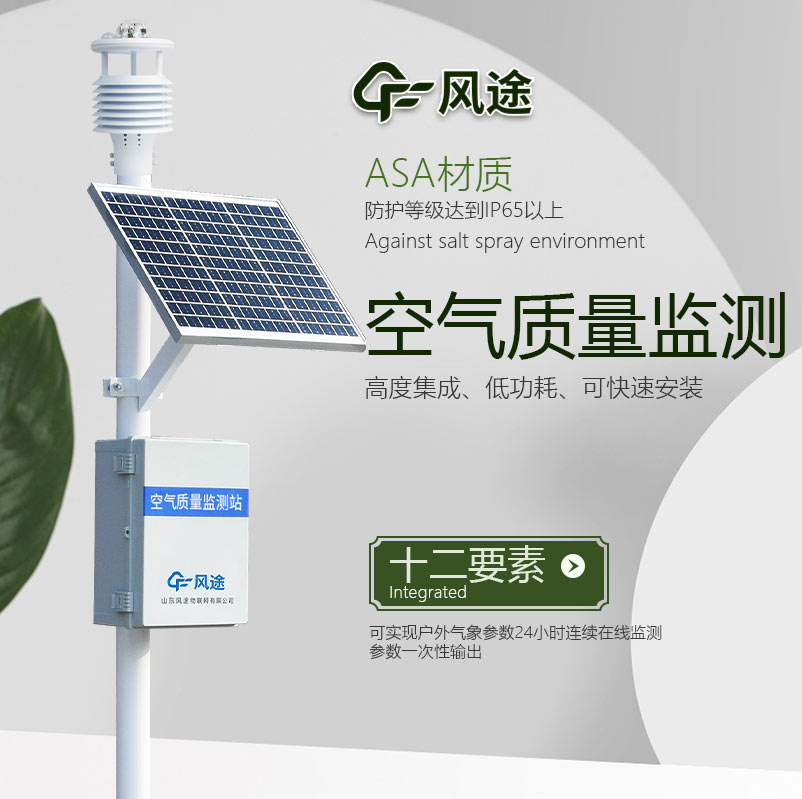
Micro Weather Station utilizes a 10-parameter integrated sensor that consolidates measurement functions for wind speed, wind direction, temperature, humidity, atmospheric pressure, illumination, optical rainfall, PM2.5, PM10, and noise. It transmits data via wired connections, Bluetooth, GPRS,...
PCR Machine supports the simultaneous detection of two fluorescently labeled targets within a single reaction well. Its 16-well sample throughput combined with a dual-channel parallel design doubles the information obtained in a single detection. The device utilizes an imported high-quality TE...
Negative Oxygen Ion Monitoring Station FT-FZ1 is an environmental monitoring device used to measure and display the concentration of negative oxygen ions in the air.The function of FT-FZ1 is to automatically monitor the concentration of negative oxygen ions in the air around the clock. Negative oxyg...
With the accelerated pace of current urban construction and the frequent occurrence of abnormal climates, the pressure on drainage facilities has increased dramatically, and traditional waterlogging drainage methods are insufficient to withstand waterlogging caused by heavy rainfall. Against this ba...


 Skype
Skype
 whatsapp
 mail
mail