Tianqiong Sensor IOT Technology Co., Ltd
Sales Manager:Ms. Emily Wang
Cel,Whatsapp,Wechat:+86 15898932201
Email:info@fengtutec.com
Add:No. 155 Optoelectronic Industry Accelerator, Gaoxin District, Weifang, Shandong, China


Sales Manager:Ms. Emily Wang
Cel,Whatsapp,Wechat:+86 15898932201
Email:info@fengtutec.com
Add:No. 155 Optoelectronic Industry Accelerator, Gaoxin District, Weifang, Shandong, China
time:2025-07-25 08:57:00 source:Weather Station viewed:409 time
Negative ions, known as the "vitamins in the air", are beneficial to human health. Medical research shows that a high-concentration negative ion environment can effectively improve human immunity, promote metabolism, soothe nerves, relieve fatigue, and even have auxiliary therapeutic effects on some diseases. When the content of negative ions reaches more than 6,000 per cubic centimeter, it can play a good auxiliary therapeutic role in hypertension, coronary heart disease, asthma and modern air-conditioning syndrome. For tourists who come to scenic spots to seek physical and mental relaxation and health care, an environment with high concentration of negative ions is undoubtedly highly attractive.
As an important place for people's leisure and vacation, the tourist experience of a scenic spot is one of its core competitiveness. High-quality air, especially high concentration of negative ions, can greatly improve tourists' comfort. When tourists are in an environment full of negative ions, they can breathe more smoothly, and their body and mind can be better relaxed, thus leaving a deeper and better impression on the scenic spot. On the contrary, if the air quality in the scenic spot is poor and the concentration of negative ions is too low, it may make tourists feel uncomfortable and reduce the reputation and attractiveness of the scenic spot.
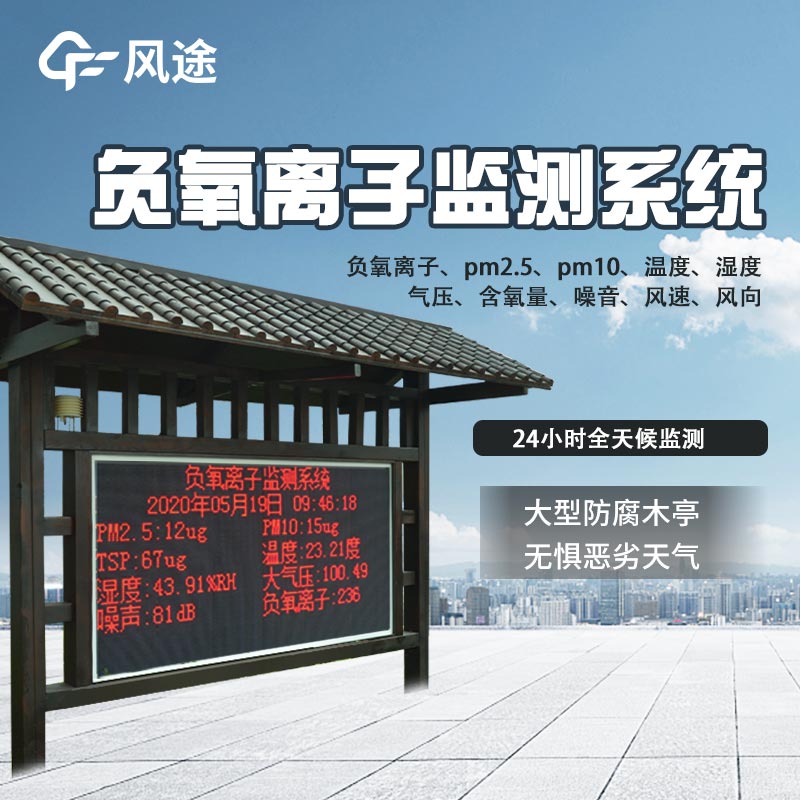
In view of the important significance of negative ions to scenic spots, the introduction of Negative Oxygen Ion Monitoring Station has become a wise choice for many scenic spots. This system can monitor the concentration of negative ions in the air of the scenic spot in real time. Through 24-hour uninterrupted monitoring, scenic spot managers can keep abreast of the air quality and detect abnormal situations in time.
The data provided by the Negative Oxygen Ion Monitoring Station provides strong support for the scientific management of scenic spots. By analyzing long-term monitoring data, scenic spot managers can understand the variation rules of negative ions in different seasons and time periods. Based on these rules, the scenic spot can make targeted management decisions, such as arranging more tourist activities in the time periods and areas with high concentration of negative ions, and strengthening environmental governance and maintenance in the time periods with low concentration. It can also adjust the types and scales of vegetation planting according to the data, optimize the self-purification capacity of water bodies, and reasonably plan tourist paths and activity areas, so as to improve the ecological value and environmental quality of the scenic spot.
The Negative Oxygen Ion Monitoring Station also helps scenic spots create differentiated competitive advantages. In today's increasingly fierce competition in the tourism market, many scenic spots are trying to find unique selling points. Publicizing high-concentration negative ions as a feature of the scenic spot, together with accurate detection data, can attract more tourists who pursue health and wellness. A canyon scenic spot successfully attracted a large number of tourists by publicizing the ultra-high concentration of negative ions in its waterfall area, and the passenger flow during the peak season increased significantly year-on-year.
Therefore, the high attention paid by scenic spots to negative ions is based on considerations of tourists' health, tourist experience and their own competitiveness. The introduction of the Negative Oxygen Ion Monitoring Station provides important technical support for scenic spots to better manage negative ion concentration, improve service quality and achieve sustainable development, and has become an indispensable part of the development of modern scenic spots.
Ground-based meteorological observation statio is a multi-parameter automatic weather station that monitors multiple parameters in real time....
The Wireless Weather Station integrates six sensors: wind speed, wind direction, temperature, humidity, air pressure, and optical rainfall. Its concealed ultrasonic probe avoids interference from rain and snow accumulation and wind obstruction. It measures wind speed and direction by emitting...
The Negative Oxygen Ion Monitoring System is a monitoring framework built on professional technologies, with its core technical architecture integrating sensing technology and IoT communication technology. The sensor employs a universal capacitive detection principle to measure the concentration of...
Fentu Technology, a manufacturer of radar water level gauges, offers an 80GHz high-frequency radar gauge utilizing Frequency Modulated Continuous Wave (FMCW) technology. With a measurement range of 0.1 to 40 meters, an accuracy of ±5 mm, and a resolution of 1 mm, this device features a non-co...



 Skype
Skype
 whatsapp
 mail
mail