Tianqiong Sensor IOT Technology Co., Ltd
Sales Manager:Ms. Emily Wang
Cel,Whatsapp,Wechat:+86 15898932201
Email:info@fengtutec.com
Add:No. 155 Optoelectronic Industry Accelerator, Gaoxin District, Weifang, Shandong, China


Sales Manager:Ms. Emily Wang
Cel,Whatsapp,Wechat:+86 15898932201
Email:info@fengtutec.com
Add:No. 155 Optoelectronic Industry Accelerator, Gaoxin District, Weifang, Shandong, China
time:2025-06-06 08:58:30 source:Weather Station viewed:565 time
Soil temperature and moisture are key factors influencing crop growth and ecological environment changes. Accurate detection of these data is of great significance for agricultural production, ecological research, and disaster prevention. Currently, multiple detection methods are available.
The soil thermometer method is a fundamental soil temperature detection technique. By inserting its sensing end into a specific depth of the soil and allowing it to stand, numerical values can be read. This method is low-cost and easy to operate, but it has low efficiency in manual reading and cannot achieve continuous monitoring. It is suitable for small-scale farmland or laboratories. The digital temperature sensor method uses integrated chips and supports multi-node networking, making it suitable for large-area farmland or greenhouse environments.
In terms of soil moisture detection, the oven-drying weighing method is the "gold standard" for detection. It calculates soil water content by measuring the mass difference before and after soil drying, offering high precision, but it is a destructive detection method. The capacitive sensor method and Frequency Domain Reflectometry (FDR) reflect soil moisture by measuring changes in soil dielectric constant or high-frequency signal propagation. These methods enable real-time monitoring with high precision and strong environmental adaptability.
With technological advancements, the soil moisture monitor has provided an efficient solution for comprehensive monitoring.
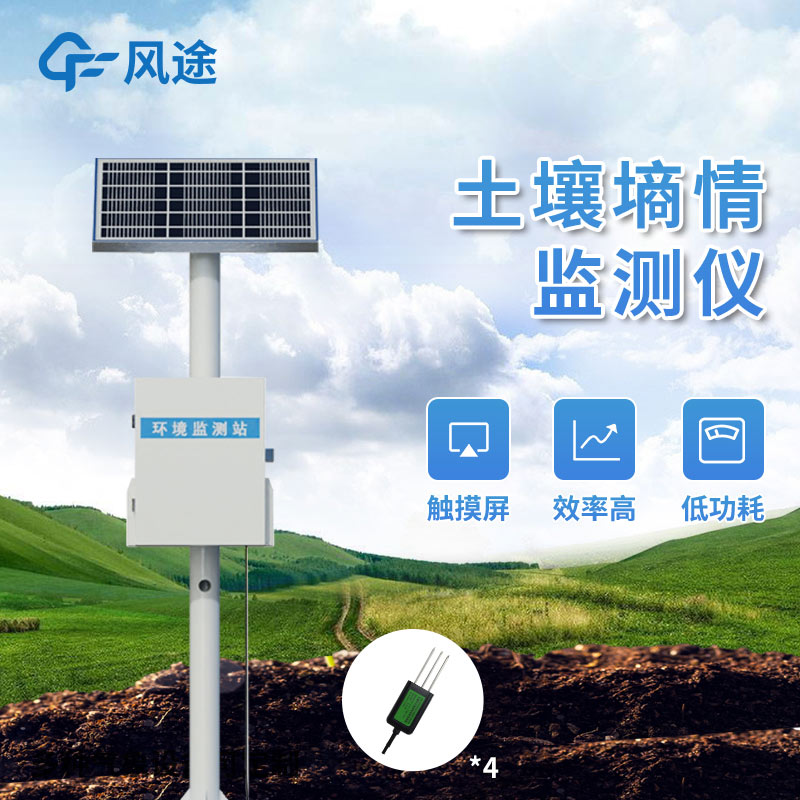
A soil moisture monitor is an automated system integrating multi-parameter monitoring, data transmission, and intelligent analysis. Its sensor layer deploys various sensors for temperature, moisture, etc. The acquisition and transmission layer aggregates data and sends it remotely, while the platform layer enables data storage, display, and early warning. Characterized by high precision and intelligence, it is widely applied in agriculture, water conservancy, ecology, and other fields. For example, it guides precision irrigation, effectively saving water and reducing crop disaster risks.
It consists of soil temperature and moisture sensors, data loggers, transmission modules, solar power supply systems, protective cases, and other components. Sensors are inserted into soil at different depths to measure temperature and moisture. After processing and storing the data, the data logger uploads it to a cloud platform or monitoring center via a transmission module. This monitoring station can continuously and real-timely monitor soil moisture conditions over the long term, providing a scientific basis for agricultural production. It helps rationalize agricultural activities, improve crop yield and quality, and offers data support for soil ecological research and environmental monitoring. This enables technicians to predict soil moisture conditions and prevent agricultural disasters in advance.
The next-generation standard Farmland Weather Station deeply integrates IoT (Internet of Things) technology and big data analysis. As a crucial tool in modern agricultural production monitoring, it provides farmers with full-process production data support from sowing to harvest.The station is speci...
In the fields of solar energy resource assessment and meteorological monitoring, the Fully Automatic Solar Spectrometer is revolutionizing traditional measurement methods. This instrument combines multi - spectral filters with thermopiles to capture radiant energy within the spectral range of 280 to...
Designed specifically for emergency rescue scenarios, this handheld weather station accurately measures multiple factors such as wind speed, wind direction, temperature, and humidity. It is suitable for all disaster emergency scenarios including fire, earthquake, and flood, and can be used in...
Transmission Line Weather Station is a specialized device designed to monitor the local meteorological environment surrounding power distribution lines. Its role is to ensure the safe and stable operation of power grids.Since distribution lines are long-term exposed in the field, they are vulnerable...


 Skype
Skype
 whatsapp
 mail
mail