Tianqiong Sensor IOT Technology Co., Ltd
Sales Manager:Ms. Emily Wang
Cel,Whatsapp,Wechat:+86 15898932201
Email:info@fengtutec.com
Add:No. 155 Optoelectronic Industry Accelerator, Gaoxin District, Weifang, Shandong, China


Sales Manager:Ms. Emily Wang
Cel,Whatsapp,Wechat:+86 15898932201
Email:info@fengtutec.com
Add:No. 155 Optoelectronic Industry Accelerator, Gaoxin District, Weifang, Shandong, China
time:2025-05-27 09:24:42 source:Weather Station viewed:403 time
Rainfall is one of the important water cycle links in nature. Accurate measurement of rainfall is of great significance for agricultural irrigation, urban flood control, water resource management, meteorological research and other fields, as it provides key data support for decision-making in these fields. So, how is rainfall measured?
In the early days, people used rain gauges to measure rainfall. A rain gauge consists of a rain receiver, funnel, water storage bottle and rain gauge cup. The diameter of the rain receiver is usually 200 mm, and it is installed with the orifice 700 mm above the ground and kept horizontal. Its working principle is to collect rainwater, measure the water volume in the water storage bottle through the rain gauge cup, and then calculate the rainfall, with a resolution of up to 0.1 mm. However, this method requires manual regular observations, and the observation frequency may need to be increased during the rainy season, which is quite inconvenient.
To achieve automatic recording of the rainfall process, self-recording rain gauges emerged. Common self-recording rain gauges include weighing type, siphon type (float type) and tipping bucket type. The weighing type continuously records the weight of the rain cup and the accumulated precipitation through a mechanical spring device or balance hammer system, and can measure snow, hail and mixed rain and snow precipitation; the siphon type uses a float to rise with the injected rainwater, driving a self-recording pen to draw a curve on a drum recording paper with a clock. When the rainfall reaches 10 mm, the water in the float chamber will be automatically siphoned and emptied. The curve on the recording paper can reflect the magnitude of rainfall and changes in the rainfall process, with a resolution of 0.1 mm and a rainfall intensity adaptation range of 0.01-4.0 mm/min; the tipping bucket rain gauge is composed of a sensor and a signal recorder. Rainwater enters the tipping bucket through the rain receiver. When the tipping bucket is filled with 0.1 mm of rainfall, it tips over, sending a pulse signal to the recorder, which controls the self-recording pen to record the rainfall. Its resolution is 0.1 mm, and the applicable range of rainfall intensity is within 4.0 mm/min. These self-recording rain gauges can also achieve wired remote transmission or wireless telemetry through electrical signals.
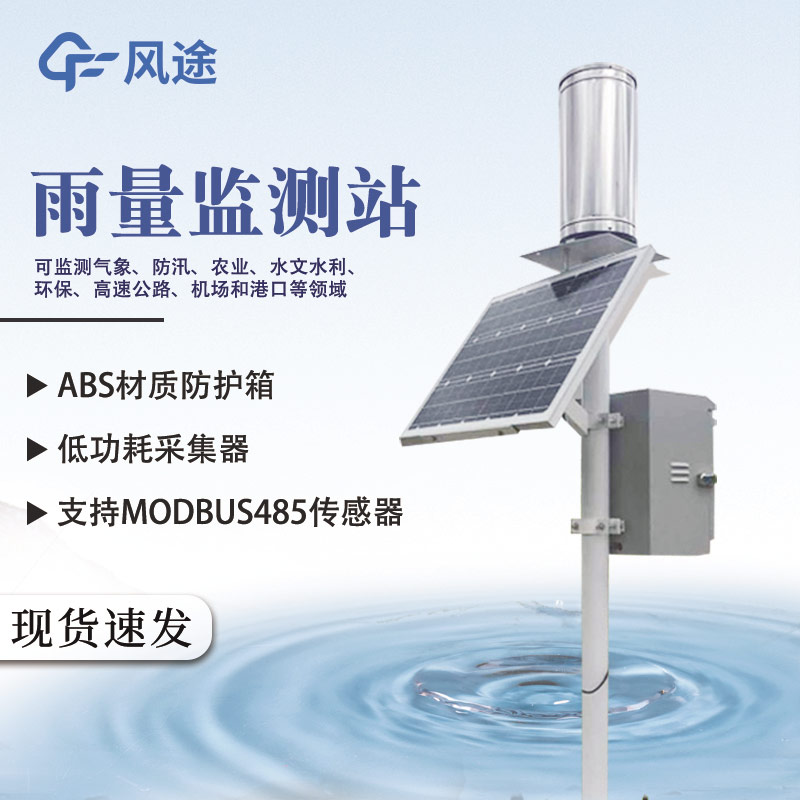
Today, rainfall monitoring stations are being widely used. It is composed of an integrated high-precision data collector, tipping bucket rain sensor, solar charging control, intelligent GPRS/GMS module and other related sensors. The monitoring station can operate fully automatically around the clock in harsh unattended environments, form a network through wired or wireless methods, and real-timely and accurately monitor and record changes in rainfall, including rich information such as rainfall status, rainfall in each data collection interval, daily rainfall, weekly rainfall, monthly rainfall and annual rainfall.
The demand for meteorological information is increasing day by day with the development of modern society. Precise meteorological data is of vital importance in fields such as agricultural production, outdoor activities, and emergency rescue. Although traditional fixed weather stations can provide s...
The FT-WQX7 Miniature sensor can monitor seven meteorological standard parameters, including ambient temperature, relative humidity, wind speed, wind direction, atmospheric pressure, rainfall, and illumination/total radiation flux. It can realize 24-hour continuous online monitoring of outdoor meteo...
The FT-ML3 Open Channel Flow Monitor is an automated system used for real-time monitoring of water flow in open channels such as rivers and irrigation canals. It is a fully automatic flow telemetry system designed for long-term, continuous monitoring of the entire water flow process in open channels...
Handheld Anemometer is a portable meteorological observation instrument. Its wind speed measurement range is 0–30 m/s with an accuracy of ±0.3 m/s and a resolution of 0.01 m/s. Wind direction measurement range is 16 azimuths with an accuracy of ±1 azimuth. The instrument uses a three-cup ro...


 Skype
Skype
 whatsapp
 mail
mail