Tianqiong Sensor IOT Technology Co., Ltd
Sales Manager:Ms. Emily Wang
Cel,Whatsapp,Wechat:+86 15898932201
Email:info@fengtutec.com
Add:No. 155 Optoelectronic Industry Accelerator, Gaoxin District, Weifang, Shandong, China


Sales Manager:Ms. Emily Wang
Cel,Whatsapp,Wechat:+86 15898932201
Email:info@fengtutec.com
Add:No. 155 Optoelectronic Industry Accelerator, Gaoxin District, Weifang, Shandong, China
time:2025-05-19 09:34:07 source:Weather Station viewed:392 time
Smart agriculture emerges from the deep integration of modern technology and agriculture. Through technologies like the Internet of Things, big data, and artificial intelligence, it achieves full-process information perception, intelligent decision-making, automatic control, and precise management in agricultural production. This helps improve agricultural production efficiency, reduce costs, enhance competitiveness, and ensure the quantity and quality safety of agricultural products. Meteorological factors play a critical role in the development of smart agriculture.
Meteorological conditions have a comprehensive impact on agricultural production. Meteorological elements such as light, temperature, precipitation, humidity, and wind speed are directly linked to crop growth, yield, and quality. Suitable meteorological conditions can promote crop photosynthesis, nutrient absorption, and growth, thereby increasing yield and improving quality. In contrast, adverse meteorological conditions may lead to stunted crop growth, the spread of pests and diseases, and the occurrence of natural disasters, causing huge losses to agricultural production. Therefore, accurately and timely obtaining farmland meteorological information is of great significance for rationally planning agricultural production, scientifically managing farmland, and enhancing agricultural benefits.
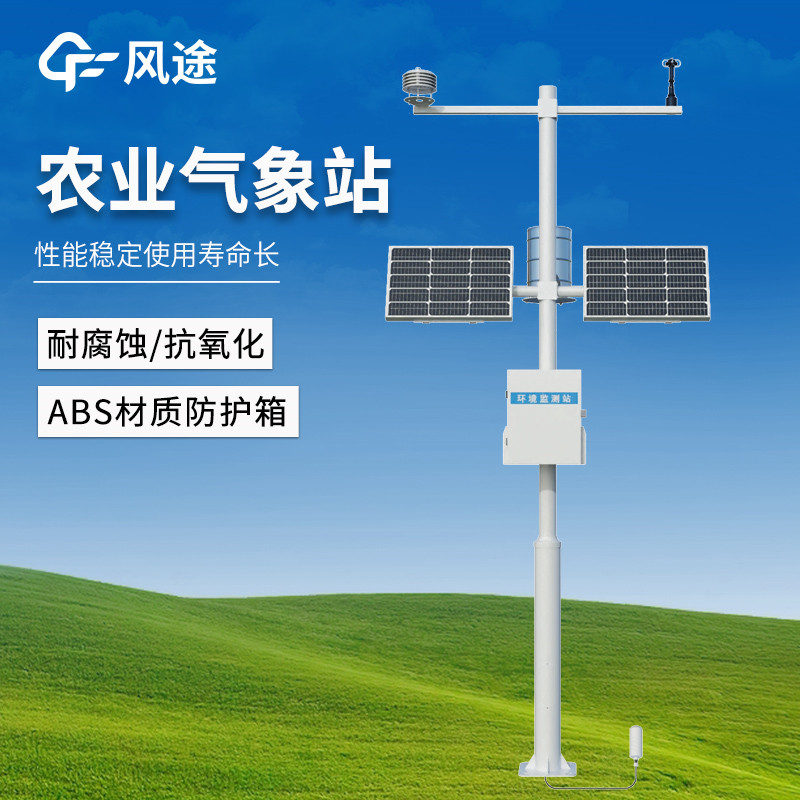
The Agricultural Environment Monitoring System is a key tool for acquiring precise meteorological information. Take Fengtu's FT-NQ14 Agricultural Environment Monitoring System as an example. This is a high-standard device capable of round-the-clock online monitoring. It consists of five components: meteorological sensors, a data collector, a solar power supply system, a vertical pole support, and a cloud platform. It features high integration, low power consumption, easy installation, and suitability for field monitoring. The meteorological sensors can accurately collect meteorological data closely related to agricultural production, including air temperature and humidity, light intensity, wind speed and direction, and rainfall. The collector has a static power consumption of less than 1mA, with a flexible data upload interval adjustable from 1 minute to 1,000 minutes. Through the standard GPRS networking, data is transmitted in real time to the cloud platform. Based on a CS architecture, the cloud platform supports direct access via mobile phones and PC browsers without additional software installation. It also enables multi-account and multi-device login, providing functions such as real-time data display and historical data dashboards. Data is stored on cloud servers, ensuring stability, reliability, and easy expansion. The platform also supports map-based display, allowing users to view device information conveniently.
With the Agricultural Environment Monitoring System, farmers can keep track of real-time meteorological changes in farmland and arrange agricultural activities such as irrigation, fertilization, and pest control reasonably based on meteorological data. This enhances the scientific and precise nature of agricultural production, contributing to the better development of smart agriculture.
Handheld Anemometer is a portable meteorological observation instrument that integrates the measurement of wind speed, wind direction, and average wind speed into a single unit. It features a wind speed measurement range of 0–60 m/s with an accuracy of ±0.3 m/s, and a wind direction range of...
Home Weather Station is a portable environmental monitoring instrument used for on-site air quality monitoring. This device can measure multiple parameters in real time, including wind speed, wind direction, temperature, humidity, air pressure, PM2.5, PM10, and noise, providing an integrated on-site data acquisition solution for environmental assessment, industrial safety, and scientific research....
Negative oxygen ions exert physiological effects on the human nervous system and blood circulation. Their concentration directly reflects air quality and serves as a key indicator for air quality assessment. The Negative Oxygen Ion Monitoring Station is specially designed to monitor this core indica...
In traditional agricultural production, there has always been a problem of lag in crop disease prevention and control. Farmers mainly rely on experience to judge diseases, and by the time obvious symptoms appear in the field, certain losses have often been caused. Blind use of pesticides is also com...


 Skype
Skype
 whatsapp
 mail
mail