Tianqiong Sensor IOT Technology Co., Ltd
Sales Manager:Ms. Emily Wang
Cel,Whatsapp,Wechat:+86 15898932201
Email:info@fengtutec.com
Add:No. 155 Optoelectronic Industry Accelerator, Gaoxin District, Weifang, Shandong, China


Sales Manager:Ms. Emily Wang
Cel,Whatsapp,Wechat:+86 15898932201
Email:info@fengtutec.com
Add:No. 155 Optoelectronic Industry Accelerator, Gaoxin District, Weifang, Shandong, China
time:2025-05-15 10:16:33 source:Weather Station viewed:407 time
Soil moisture automatic measurement relies on multiple sensor technologies. For soil water content measurement, Frequency Domain Reflectometry (FDR) and Time Domain Reflectometry (TDR) are commonly used. FDR sensors calculate water content by measuring the soil's dielectric constant, as there is a positive correlation between soil water content and dielectric constant. TDR sensors, on the other hand, emit high-frequency electromagnetic pulses into the soil and calculate soil water content based on the pulse propagation time and reflection signals in the soil. Soil temperature is measured using thermistors, whose resistance values change with temperature and are converted into temperature values through circuits. Salt sensors reflect soil salinity by measuring the electrical conductivity of the soil solution.
Data collected by these sensors undergo analog-to-digital conversion, storage, and preliminary processing by a data collector, and are then transmitted in real time to a data center via wireless communication technologies such as GPRS and 4G. Staff can intuitively view soil moisture data at each monitoring point through specialized monitoring software.
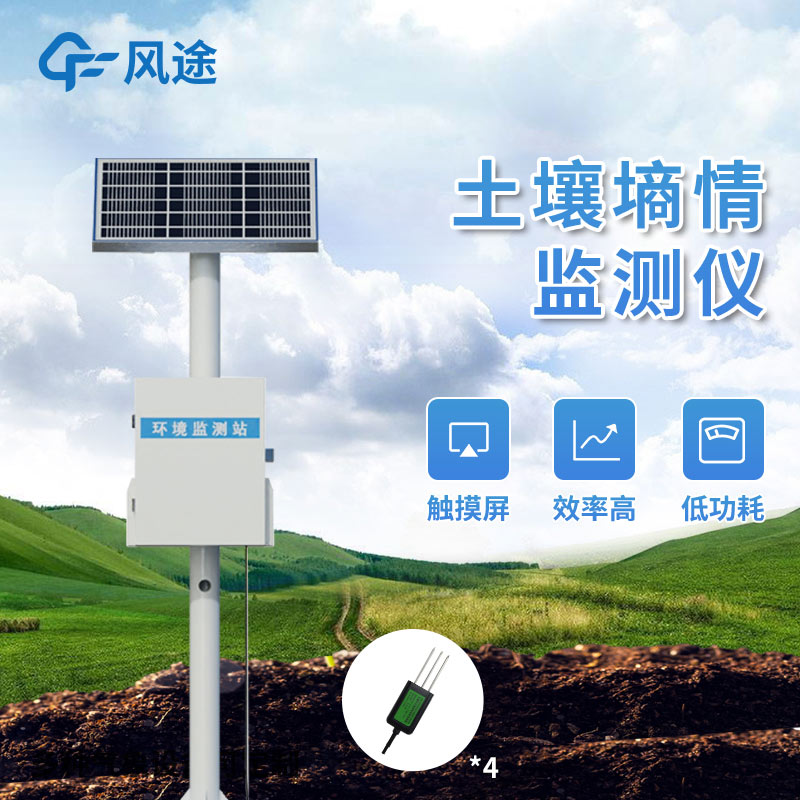
A soil moisture monitoring station is a comprehensive device integrating the above measurement technologies. It typically consists of sensors, a data collection and transmission system, a solar power supply system, a protective chassis, and other components. After being deployed in farmland, forest land, and other areas, it can automatically collect soil moisture data at set frequencies, unaffected by weather and time. The data center can receive data from multiple monitoring stations, generate soil moisture trend charts and early warning information through data analysis models. When the soil water content falls below the suitable range for crop growth, the system automatically issues irrigation warnings; if the salinity is too high, it prompts soil improvement.
Soil moisture monitoring stations have realized the automation and intelligence of soil moisture monitoring, providing reliable data support for precise agricultural irrigation and scientific management, and are of great significance for improving water resource utilization efficiency and ensuring crop growth.
Water quality micro monitoring station is a miniaturized, integrated, and intelligent online water quality monitoring system. This device integrates five measurement modules—total phosphorus, total nitrogen, chemical oxygen demand, permanganate index, and ammonia nitrogen—as well as conventi...
Air quality monitoring stations are compact in size and occupy a small footprint, making them easy to install and deploy. They can be flexibly set up in various locations, such as urban streets, parks, schools, communities, and industrial parks, and even installed on external walls of buildings or s...
The FT-ML3 Open Channel Flow Monitor is an automated system used for real-time monitoring of water flow in open channels such as rivers and irrigation canals. It is a fully automatic flow telemetry system designed for long-term, continuous monitoring of the entire water flow process in open channels...
In modern traffic management, real-time and accurate road condition monitoring is of great significance for ensuring driving safety and improving road operation efficiency. Traditional road weather stations typically require embedded installation, which not only damages the road structure but may al...



 Skype
Skype
 whatsapp
 mail
mail