Tianqiong Sensor IOT Technology Co., Ltd
Sales Manager:Ms. Emily Wang
Cel,Whatsapp,Wechat:+86 15898932201
Email:info@fengtutec.com
Add:No. 155 Optoelectronic Industry Accelerator, Gaoxin District, Weifang, Shandong, China


Sales Manager:Ms. Emily Wang
Cel,Whatsapp,Wechat:+86 15898932201
Email:info@fengtutec.com
Add:No. 155 Optoelectronic Industry Accelerator, Gaoxin District, Weifang, Shandong, China
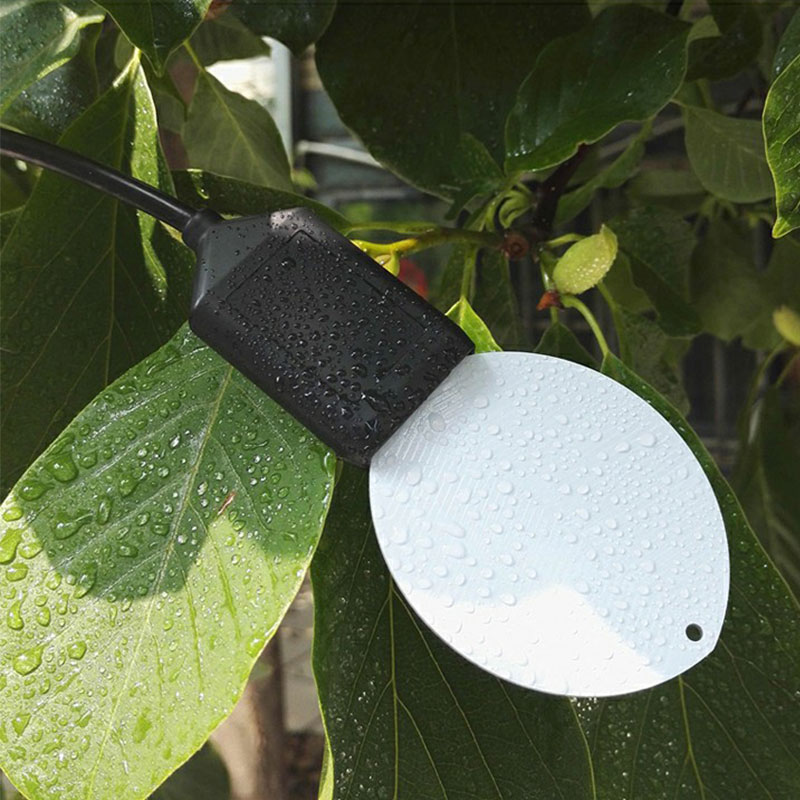
Model:FT-YSW
Brand:tianqiong
1.Leaf Wetness Sensor product overview
Leaf Wetness Sensor is used to monitor surface moisture on leaves, measuring leaf wetness via a grid-like, resistance-based sensor.The Leaf Wetness Sensor consists of a high-precision thermistor and a transmitter to accurately measure temperatures over the entire range.The humidity sensor is based on the principle of dielectric constant measurement, simulating the shape of the blade and truly simulating the surface characteristics of the blade.Humidity can be accurately measured by changes in the surface dielectric constant of the blade.It has good sensitivity and can detect trace moisture residues on the surface of the blade.The leaf temperature and humidity transmitter adopts a waterproof design, low power consumption and can be continuously monitored for a long time.Easy to install, can be hung inside a greenhouse or on the branches of trees for long-term uninterrupted monitoring.Widely used to measure the surface humidity of plants or objects such as greenhouses, laboratories, aquaculture, production environment, artificial climate chambers, etc.
2.Features of Leaf Wetness Sensor
1.Imitate the leaf characteristics and quickly and accurately measure temperature and humidity.
2.Dense leaf vein patterns (15 strips/cm), which can detect smaller droplets and make measurements more sensitive.
3.The humidity measurement is sensitive and can accurately detect the surface humidity of the leaf surface.
4.High accuracy, fast response and good interchangeability.
5.Epoxy resin packaging, waterproof and moisture-proof, and has a longer lifespan.
3.Leaf Wetness Sensor Technical Parameters
| DC power supply (default) | DC 5-30V | |
| Maximum power consumption | 0.75W (12V DC powered) | |
| Operating temperature | -40℃~+60℃ | |
| Humidity parameters | Range | 0-100%RH |
| Resolution | 0.1%RH | |
| Accuracy | ±3% (@0-50%, 25℃) | |
| Temperature parameters | Range | -40~80℃ |
| Resolution | Resolution: 0.1℃ | |
| Accuracy | ±0.5℃ (@25℃) | |
| Protection level | IP67 | |
| Sealing material | Black flame retardant epoxy resin | |
| Default cable length | 2 meters, cable length can be customized according to requirements | |
| External dimensions | 65*15*138.5mm | |
| Output signal | RS485 (Modbus protocol) | |
Compared with traditional embedded sensors, the Road Condition Monitor has distinct advantages in practical applications. It adopts non-intrusive installation, which does not require damaging the road surface structure. The installation process is simple and convenient, which can greatly reduce the...
Negative oxygen ions are negatively charged particles formed when oxygen molecules combine with free electrons through natural processes. Known as the "air freshening factor", they not only purify the air but also regulate human health. They can adsorb dust and odor molecules, and improve...
In fields such as water conservancy and hydrological monitoring, there are various methods for measuring flow velocity. Common ones include the buoy method, the propeller current meter method, etc. The buoy method determines the flow velocity by observing the movement speed of the buoy in the water...
Modular Weather Station is a high-precision, automated meteorological observation device that integrates the measurement of multiple parameters—including wind speed, wind direction, temperature, humidity, atmospheric pressure, PM2.5, PM10, and noise—into a single unit. Characterized by its c...


 Get a Free Quote

 Skype
Skype
 whatsapp
 mail
mail