Tianqiong Sensor IOT Technology Co., Ltd
Sales Manager:Ms. Emily Wang
Cel,Whatsapp,Wechat:+86 15898932201
Email:info@fengtutec.com
Add:No. 155 Optoelectronic Industry Accelerator, Gaoxin District, Weifang, Shandong, China


Sales Manager:Ms. Emily Wang
Cel,Whatsapp,Wechat:+86 15898932201
Email:info@fengtutec.com
Add:No. 155 Optoelectronic Industry Accelerator, Gaoxin District, Weifang, Shandong, China
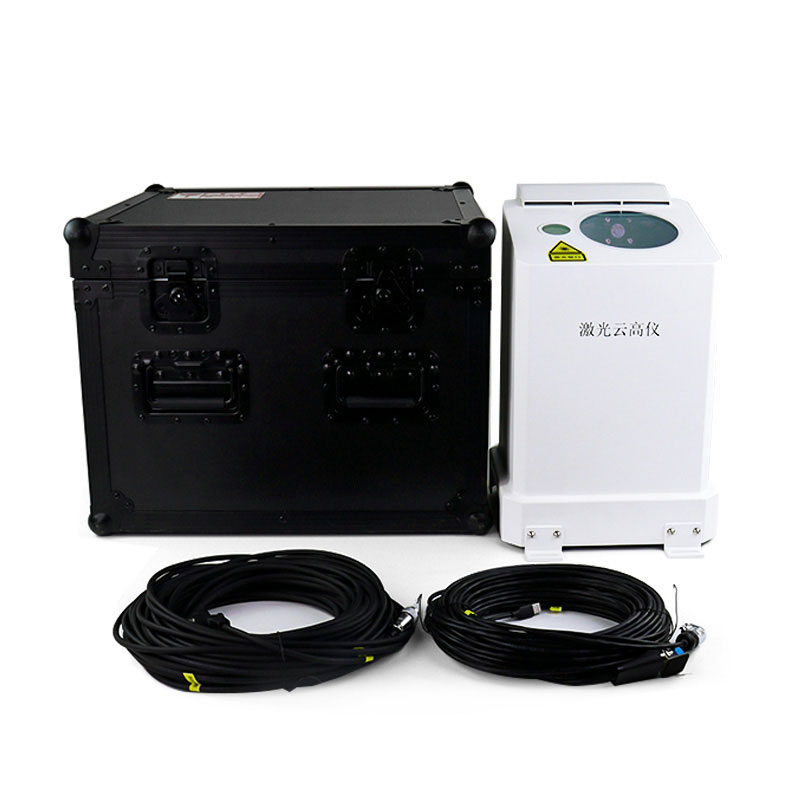
Model:FT-YG1
Brand:tianqiong
1、Laser ceilometer Product Overview
laser ceilometer is a device that uses a laser to determine the height of a cloud ceiling or cloud base and also measures cloud cover and vertical visibility.Laser ceilometer By utilizing the Mie scattering effect of atmospheric aerosol particles on laser light, it is possible to detect aerosols—such as dust, clouds, and fog—within the lower atmosphere (below 15 km); this technique is known as Mie scattering lidar. Compared to other scattering mechanisms, Mie scattering features a larger scattering cross-section, resulting in stronger echo signals; furthermore, since most atmospheric aerosol particles are concentrated at lower altitudes, they are relatively easy to detect. This technology is primarily deployed at airports, aboard ships, on mobile measurement vehicles, and at meteorological stations to measure parameters such as cloud base height and integrated cloud amount.
2、Laser ceilometer Working Principle
Laser ceilometer Based on the principles of laser ranging, a transmitter emits periodic laser pulses into the atmosphere; a receiver captures the backscattered signals from clouds and the atmosphere; and a processor processes the received signals. Through inversion calculations, the atmospheric extinction coefficient at various altitudes is determined, thereby enabling the identification of cloud layers and the calculation of cloud base heights.
3、Laser ceilometer Equipment Components
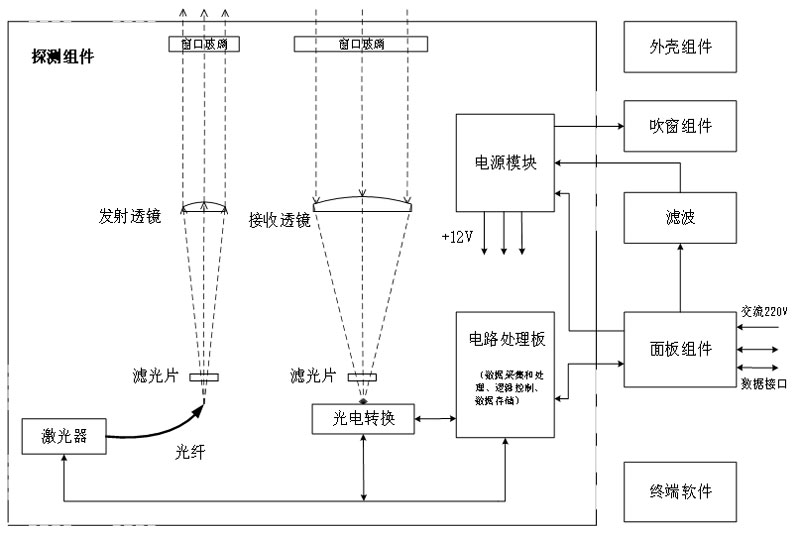
Laser ceilometer is an intelligent atmospheric sensing device centered on optoelectronic technology. It consists of a detection module, optoelectronic conversion unit, data acquisition and processing unit, logic control unit, data storage unit, terminal software, housing assembly, and other components. The functional principle and composition are illustrated in Figure 2.
Detection Module: Composed of a structural frame, a transmitting sub-module, and a receiving sub-module. The frame provides structural support; the transmitting sub-module generates and emits laser pulses; and the receiving sub-module captures the echo signals and, via optoelectronic conversion, converts them into electrical signals.
Data Acquisition and Processing: Performed by a circuit processing board operating under the control of embedded software; this unit acquires the echo signals, processes the raw data, and retrieves information such as cloud height through data inversion algorithms.
Logic Control: Executed by the circuit processing board in conjunction with the embedded software to manage timing logic; this unit ensures that the laser emitter, data acquisition system, and information transmission components operate cyclically and in strict accordance with predetermined timing requirements.
Data Storage: Managed by the circuit processing board and embedded software, which periodically store historical data in a predetermined format.
Housing Assembly: Provides structural support and physical protection for all other components of the device.
Window Blower Module: Composed of a fan and a PTC heating element, this module prevents condensation from forming on the optical window glass. It activates immediately upon power-up and continuously blows warm air.
Terminal Software: Installed on an external terminal computer, this software communicates in real-time with the circuit processing board via RS485 or RJ45 interfaces. Its primary functions include command execution and status monitoring, data parsing, data storage, data retrieval, and user interface display.
Laser ceilometer The block diagram of the principle and composition is as follows:
4、Laser ceilometer Technical Specifications
4.1 Main Functions
The main functions of the device are as follows:
a) Capable of measuring and displaying cloud base height, cloud layer thickness, and atmospheric boundary layer height; outputs vertical visibility when the sky is obscured;
b) Multi-layer cloud measurement function: Capable of detecting up to 5 cloud layers, measuring the cloud base height, cloud thickness, and integrated cloud amount for each layer;
c) Self-diagnostic function: The device can automatically detect the operational status or parameters of its key internal components;
d) Parameter configuration and power-loss protection: Parameters can be configured via external terminal software; furthermore, configured parameters are retained even after a power outage;
e) Data format: Complies with the data format specifications for ceilometers as defined in the *Ground-based Meteorological Observation Data Dictionary*;
f) The device features automatic control functions, including self-cleaning and self-heating capabilities;
g) Capable of storing up to 3 months of historical data.
4.2 Performance Specifications
a) Cloud height measurement range: 15 – 15,000 m;
b) Cloud height resolution: 5 m;
c) Number of detectable cloud layers: ≥ 5 layers;
d) Distance measurement error for fixed targets: ≤ 5 m.
4.3 Physical Characteristics
a) Dimensions (L × W × H): ≤ 320 × 330 × 480 mm;
b) Weight: ≤ 20 kg.
4.4 Electrical Performance
a) Power supply: AC 220 V (±15%), 50 Hz ±2.5 Hz;
b) Power consumption: ≤ 100 W.
4.5 Data Transmission
a) Interface type: RJ45 and RS485 (selectable);
b) Baud rate: Configurable to 9600 bps, 19200 bps, 38400 bps, 57600 bps, or 115200 bps;
c) Data update cycle: Continuously adjustable from 20 s to 120 s.
4.6 Environmental Adaptability
a) IP65 Protection Rating;
b) Operating Temperature and Humidity:
1) Ambient temperature: -45°C to +50°C;
2) Relative humidity: 5% to 100%. c) Storage Temperature and Humidity
1) Ambient Temperature: -55°C to 60°C;
2) Relative Humidity: 5% to 100%.
4、Laser ceilometer Installation Precautions
a) The equipment should be installed in an open area free of significant obstructions in the surrounding vicinity.
b) To prevent contamination of the optical window system caused by direct sunlight, the equipment must be installed in accordance with the following principles: if installed in the Northern Hemisphere, the window should face North; if installed in the Southern Hemisphere, the window should face South.
c) Construct a suitable foundation based on the dimensions of the equipment; a minimum size of 800 mm x 800 mm is recommended.
In traditional cognition, agricultural production has often "relied on the weather", and weather changes have a huge impact on crop growth. Especially during the Sanfu days (the peak summer heat period), extreme weather such as high temperatures, high humidity, and heavy rainfall occurs fr...
Micro Weather Station utilizes a 10-parameter integrated sensor that consolidates measurement functions for wind speed, wind direction, temperature, humidity, atmospheric pressure, illumination, optical rainfall, PM2.5, PM10, and noise. It transmits data via wired connections, Bluetooth, GPRS,...
Climate change is leading to more frequent and intense extreme weather events (such as droughts, floods, heatwaves, and late spring cold snaps). These weather events cause devastating impacts on agricultural production. Traditional, experience-dependent farming models struggle to cope with this unce...
Negative oxygen ions exert a significant impact on the physiological activities of the human body, and their effects are mainly realized through the nervous system and blood circulation process. For this reason, the concentration of negative oxygen ions in the air has become one of the key indicator...


 Get a Free Quote
 Skype
Skype
 whatsapp
 mail
mail