Tianqiong Sensor IOT Technology Co., Ltd
Sales Manager:Ms. Emily Wang
Cel,Whatsapp,Wechat:+86 15898932201
Email:info@fengtutec.com
Add:No. 155 Optoelectronic Industry Accelerator, Gaoxin District, Weifang, Shandong, China


Sales Manager:Ms. Emily Wang
Cel,Whatsapp,Wechat:+86 15898932201
Email:info@fengtutec.com
Add:No. 155 Optoelectronic Industry Accelerator, Gaoxin District, Weifang, Shandong, China
time:2025-07-22 08:58:48 source:Weather Station viewed:537 time
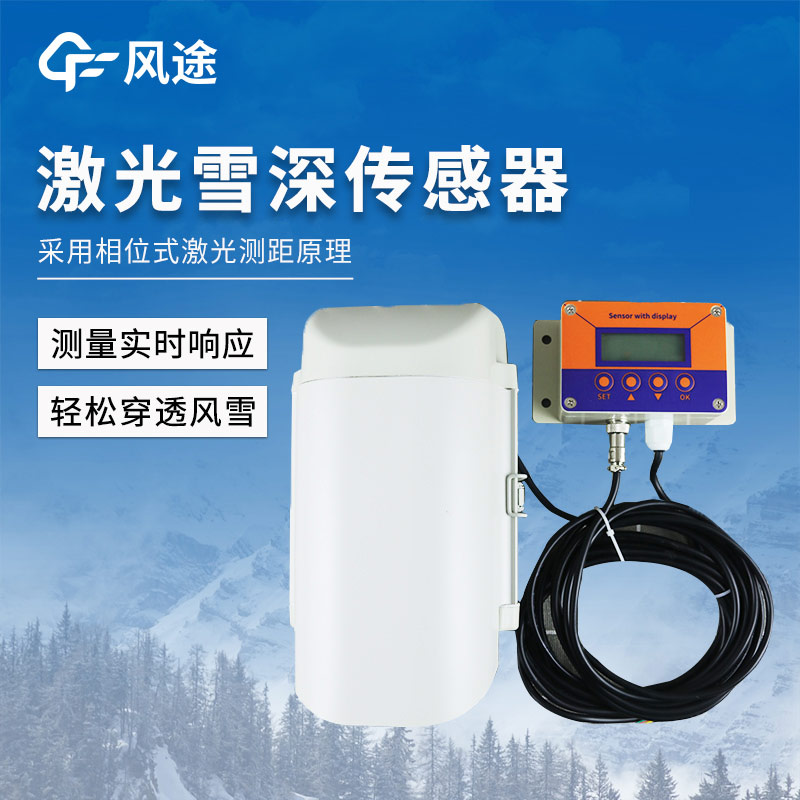
In the road traffic environment safety monitoring system, the Laser Snow Depth Monitor, especially in areas with frequent snowfall in winter, can accurately and real-time monitor the depth of snow on the road surface. It provides key data for traffic management departments, helping to ensure road safety and smooth flow.
The Laser Snow Depth Monitor mainly works based on the principle of laser ranging. The device emits a laser beam to the road surface. When the laser beam hits the snow surface, part of the light is reflected back to the sensor. The sensor accurately measures the time difference between the emission of the laser and the reception of the reflected light. Combined with the known constant of the speed of light, it can accurately calculate the distance between the sensor and the snow surface. Since the installation height of the sensor is fixed, real-time snow depth data can be obtained through simple mathematical operations. For example, after a certain type of sensor emits a laser, it receives the reflected light in a very short time. It is calculated that the distance between the sensor and the snow surface is 2 meters, and the known installation height of the sensor is 3 meters, so the current snow depth is 1 meter.
Regarding the advantages of this sensor, first of all, it has high precision, with a measurement accuracy of up to the millimeter level, which can accurately reflect subtle changes in snow depth and provide accurate data support for traffic decision-making. Secondly, it has strong real-time performance. It can continuously monitor snow depth without interruption, quickly collect and transmit data at set time intervals (such as every minute), so that traffic management departments can keep abreast of snow conditions at any time. Finally, it has excellent ability to adapt to harsh environments. It can work stably in harsh weather conditions such as low temperature, strong wind, and heavy snow, ensuring the continuity and reliability of data.
On expressways, management departments use sensor data to timely judge road snow conditions. When the snow depth reaches a certain level, they can start snow removal emergency plans in advance and rationally deploy equipment such as snowplows and snow-melting agent spreaders to ensure driving safety on expressways.
Especially for mountain roads, due to complex terrain and changeable climate, snow has a greater impact on traffic. The sensor can monitor in real time, helping relevant departments to issue early warnings and take measures such as road closure and traffic restriction when necessary to avoid traffic accidents.
In cities, municipal departments reasonably arrange the order of snow removal operations according to the feedback from sensors, giving priority to clearing key sections such as main roads, bridges, and steep slopes, so as to improve snow removal efficiency and reduce the impact of snow on citizens' travel.
The UAV visibility meter is designed with full consideration of the requirements for UAV mounting. It features a lightweight and compact design, enabling it to be easily adapted to various small UAV platforms and reducing the burden on the UAV during flight. At the same time, the flat body design ca...
Two - dimensional ultrasonic anemometers can only measure two parameters: wind speed and direction on the horizontal plane. They cannot obtain information about the wind in the vertical direction, such as vertical wind speed or the upward/downward speed of vertical airflows. Therefore, they are only...
Home Weather Station is a portable environmental monitoring instrument used for on-site air quality monitoring. This device can measure multiple parameters in real time, including wind speed, wind direction, temperature, humidity, air pressure, PM2.5, PM10, and noise, providing an integrated on-site data acquisition solution for environmental assessment, industrial safety, and scientific research....
In the context of the increasingly accelerating urbanization process today, air quality has become one of the key elements for measuring the quality of life. However, due to the high construction and operation costs and fixed layout, traditional large-scale environmental monitoring stations find it...


 Skype
Skype
 whatsapp
 mail
mail