Tianqiong Sensor IOT Technology Co., Ltd
Sales Manager:Ms. Emily Wang
Cel,Whatsapp,Wechat:+86 15898932201
Email:info@fengtutec.com
Add:No. 155 Optoelectronic Industry Accelerator, Gaoxin District, Weifang, Shandong, China


Sales Manager:Ms. Emily Wang
Cel,Whatsapp,Wechat:+86 15898932201
Email:info@fengtutec.com
Add:No. 155 Optoelectronic Industry Accelerator, Gaoxin District, Weifang, Shandong, China
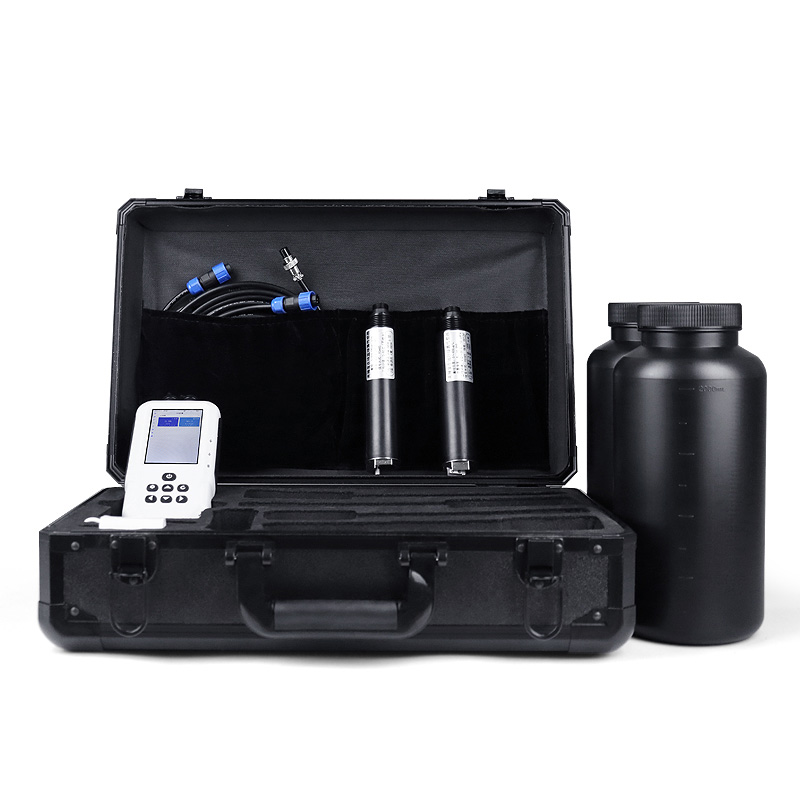
Model:FT-SS02
Brand:tianqiong
1.Product introduction of Blue Green Algae Test
Blue Green Algae Test uses fluorescence to find out whether there is blue-green algae in the water and can detect most floating blue-green algae.Blue Green Algae Test is an electrode-based water quality analysis instrument that uses all-digital electrode detection to detect two parameters of water quality chlorophyll and blue-green algae.The instrument is equipped with a self-developed FTIOT operating system, which has simple operation, stable performance, accurate measurement, wide detection range, and has a built-in high-capacity rechargeable lithium battery, which is convenient for users to conduct water quality inspection at any time in the field and in the laboratory.
2.Blue Green Algae Test host parameters
| Charging input voltage | 4.5V-5.5V |
| Charging current | <2A |
| Screen size | 3.5 inches |
| Screen resolution | 480*800☆ |
| Screen interface | MIPI DSI☆ |
| USB port | 2 (Support external expansion of mouse, keyboard, 4G, etc.)☆ |
| Type-C | 1 (Support external expansion of mouse, keyboard, 4G, etc.)☆ |
| RS485 | 2 (Support Modbus, json, asc input, etc.) |
| External sensor power supply voltage | 12V |
| External sensor power supply current | 1A |
| operating system | ftiot (based on Linux-5.4)☆ |
| CPU | 2*Cotex-A7, 650Mhz☆ |
| RAM | 512M DDR3☆ |
| Flash | 8G-64G |
| OpenGL | ES 2.0☆ |
| Wifi | support |
| 4G | Selection |
| button | support |
| Capacitive touch screen | support |
| Software Architecture | B/S☆ |
| Web access | Support ☆ |
| MTP mode | Support ☆ |
| Multi-terminal login | Support ☆ |
| IPV6 | Support ☆ |
| Sensor communication method | RS485, TCP, UDP, Http☆ |
| Data forwarding method | RS485, TCP, UDP, Http☆ |
| Remote SSH | Support ☆ |
| Remote debugging | Support ☆ |
3.Blue Green Algae Test sensor parameters and configuration
| Serial number | name | Measurement range | principle | Measurement accuracy | Resolution | Configuration | Remark |
| 1 | temperature | 0~50℃ | High-precision digital sensor | ±0.3℃ | 0.01℃ | ||
| 2 | pH | 0~14 (ph) | Electrochemistry (salt bridge) | ±0.1PH | 0.01 | ||
| 3 | ORP | -1500mv~1500mv | Electrochemistry (salt bridge) | ±6mv | 1mV | ||
| 4 | Conductivity | 0~5000uS/cm, 0~10000uS/cm | Contact electrode method | ±1.5% | 1uS/cm | ||
| 5 | TDS | 0-10000ppm 0-200ppt | Contact electrode method | ±1.5%; ±0.1°C | 1ppm 0.01ppt | ||
| 6 | salinity | 0-10000ppm 0-200ppt | Contact electrode method | ±1.5%; ±0.1°C | 1ppm 0.01ppt | ||
| 7 | Sludge concentration | 0~20.000g/L | Scattering light method | ±5% (depending on sludge homogeneity) | 0.001g/L | ||
| 8 | Turbidity | 0~40NTU (low turbidity) | Scattering light method | ±1% | 0.1NTU | Optional | |
| 0~1000NTU (medium turbidity) | Scattering light method | ±1% | |||||
| 0~3000NTU (high turbidity) | Scattering light method | ±1% | |||||
| 9 | Dissolved oxygen | 0~20mg/L | Fluorescence life method | ±2% | 0.01mg/L | ||
| 10 | Ammonia nitrogen | 0-1000.00mg/L (default) 0-100.00mg/l/ (customizable) | Ion Selection Electrode Method | 10% of reading, ±0.5℃ | 0.01mg | ||
| 11 | Suspension | 0~2000mg/L | Scattering light method | ±5% (depending on sludge homogeneity) | 0.1mg/L | ||
| 12 | Residual chlorine | 0~5.00mg/L | Ion Selection Electrode Method | ±5% of reading | 0.01mg/L | The best accuracy is when the flow rate is 0.42m/s-0.85m/s | |
| 13 | Chloride ions | 0-3500.0mg/L | Ion Selection Electrode Method | ±5% | 0.1mg/L | ||
| 14 | Total hardness | 0~1000.0mg/L | Ion Selection Electrode Method | ±10% of reading | 0.1mg/L | ||
| 15 | cod | 0~500mg/L | UV254 absorption method | ±5% | 0.1mg/L | COD, chlorophyll, and blue-green algae are equipped with automatic cleaners, which can prevent biological adhesion and avoid light window pollution, so as to ensure that long-term monitoring is still stable; automatic cleaning time and cleaning times can be set, and the power consumption is 0.7W | |
| 16 | Chlorophyll | 0~400ug/L | Fluorescence method | R2>0.999 | 0.01ug/L | ✔ | |
| 17 | Blue-green algae | 0~200.0Kcells/mL | Fluorescence method | R2>0.999 | 0.1Kcells/mL | ✔ |
As the name suggests, an air quality sensor monitors carbon monoxide (CO), sulfur dioxide (SO₂), nitrogen dioxide (NO₂), and ozone (O₃). CO mainly comes from incomplete combustion of fuels, such as automobile exhaust and industrial waste gas emissions. SO₂ is mostly produced by the combustion of...
Vehicle-mounted anemometer and wind direction sensor is a meteorological monitoring device specifically designed for mobile platforms. It utilizes a two-element integrated ultrasonic sensor to provide real-time wind speed and direction measurements. Its top cover features a concealed probe des...
In the field of meteorological monitoring, refined monitoring has become a trend. As an important part of refined monitoring, micro-meteorological monitoring is dedicated to obtaining more accurate and detailed meteorological information. It focuses on the changes of meteorological elements within a...
The Atmospheric Environment Monitoring System serves as a monitoring unit in grid-based monitoring systems. It adopts a miniaturized design enabled by sensor technology, capable of flexibly detecting one or more of various pollutant parameters, including PM10, PM2.5, SO2, NO2, CO, O3, and TVOC. This...


 Get a Free Quote
 Skype
Skype
 whatsapp
 mail
mail